Miro: 6 in 10 are bogged down with busy work that doesn’t drive innovation – can AI help?
According to new research from Miro, employees are struggling with communication silos and having to switch between tools; this means that although they are working more, 55% feel they are getting less done. How can AI help to fix these productivity challenges? UNLEASH digs into the data with Miro’s CIO.
News In Brief
Workers are spending three times as long on repetitive tasks as they are on high-impact, strategic work, and it is impacting their productivity.
That's according to new research from collaboration platform Miro.
Read on to find out why AI is part of the solution, but it is not a cure all.
For every hour that workers spend on creative and strategic work that drives momentum and innovation, they are spending three hours on repetitive tasks like meetings, emails and paperwork.
That’s according to new data from collaboration platform Miro ‘s 2025 Momentum at Work report.
While some of those repetitive, maintenance tasks are a necessity, spending so little time on what Miro calls ‘momentum work’ means that work is reactive, not strategic.
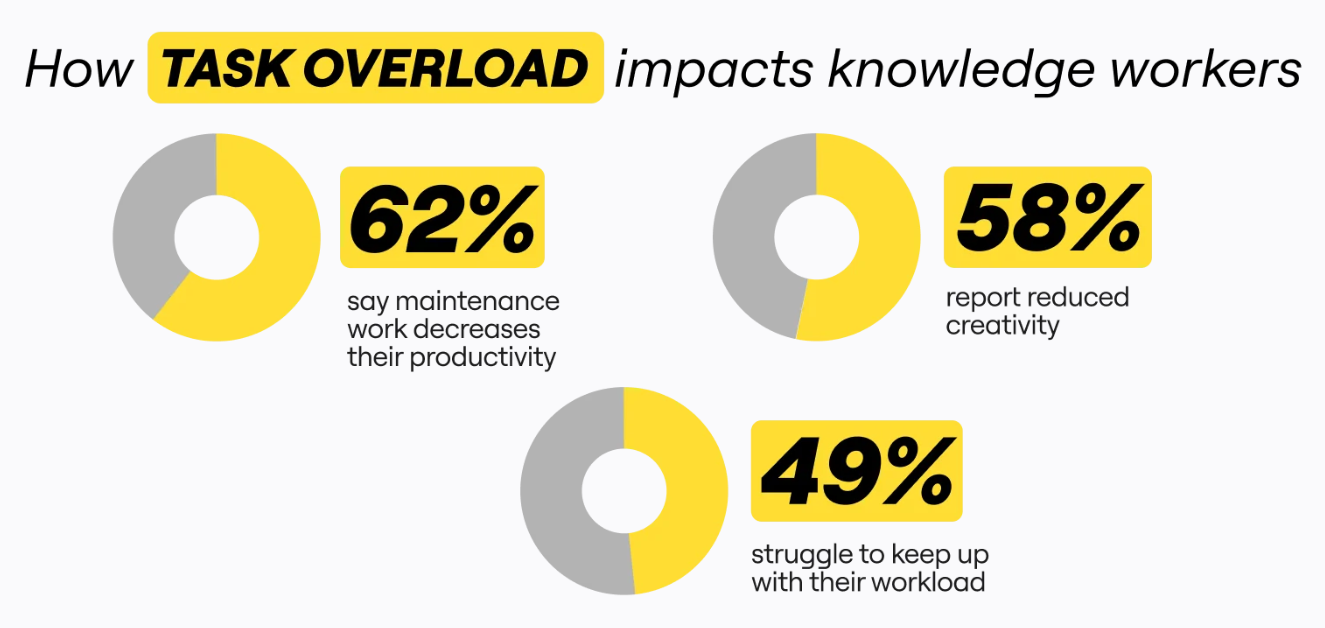
Six in ten of the 6,100 knowledge workers across the world surveyed by Miro said that maintenance, repetitive work stalls momentum at their company.
Workers are grappling with task overload, which damages their productivity and their wellbeing.
Credit: Miro.
55% say they are working more, but getting less done, and 68% are experiencing emotional overload at least twice a month.
Workplace silos are always contributing to this repetitive work – 63% told Miro that info and data are often held across fragmented toolsets, while 57% noted communication silos and 59% stated that silos cause to much context switching, which is distracting.
How can workers, and organizations, away from reactive and towards more strategic work? UNLEASH digs into the full data, and speaks to Tomás Dostal Freire, CIO & Head of Business Transformation at Miro, to find out.
AI as a solution, but not a silver bullet
“The survey results are clear. Business leaders must recognize that maintenance work and silos are undermining both innovation and morale.
“Employees do not want to be buried in repetitive individual tasks.
“They want the freedom to collaborate on creative and strategic projects that ignite their passions and move their business forward,” Dostal Freire tells UNLEASH.
Therefore, according to Dostal Freire, “organizations need to provide the right tools and develop the structures that make true collaboration possible”.
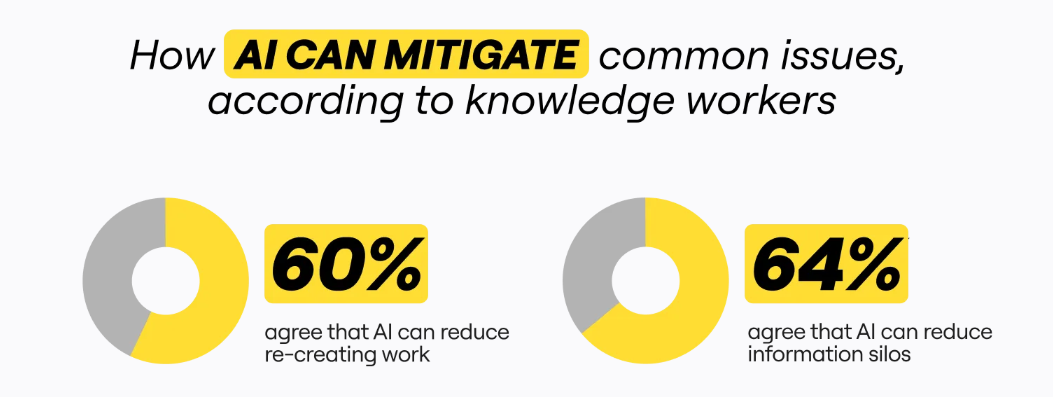
AI seems to be the tool of choice – according to Miro’s report, knowledge workers are very optimistic about the potential of AI to reduce repetitive work, as well as close silos.
They believe AI can help with administrative work (55%), reduce the need to redo work across tools (60%), as well as reduce the task load from meeting prep (45%) and follow ups (46%).
Credit: Miro.
However, Miro’s report is very clear that AI is not a cure all.
Dostal Freire adds: “The priority is to adopt AI in ways that extend beyond individual task automation.
“Encouraging employees to use AI in isolation risks deepening the communication and data silos identified in the report.”
“We have found that meaningful transformation… happens when AI is implemented across the full team to tackle the obstacles that limit collaboration and progress,” he continues.
With this approach, leaders can empower employees to focus on the high-value work they enjoy, while accelerating growth and delivering stronger results for the business.”
This confirms recent data from Atlassian – the tech giant surveyed 12,000 knowledge workers & 180 Fortune 100 executives; the data showed that AI is a real boom for productivity, but 96% businesses weren’t seeing dramatic improvements in organizational efficiency, innovation of work quality.
As a result, organizations are struggling to reap the full rewards of AI.
Dr Molly Sands, Head of Teamwork Lab at Atlassian, tells UNLEASH: “The real value comes when AI helps teams share context, connect the dots, and solve problems together”.
Leaders need to be clear about “the outcomes you want to achieve, make it easy for people to capture and share knowledge as part of their daily work, make AI available to every team and experiment to see where it can make a difference”.