Jaime Teevan: AI is already changing work; HR now has the opportunity define the organizations that emerge
“The biggest mistake that an organization can make now is to optimize for individual productivity without thinking about collective efficiency,” stated Jaime Teevan, Microsoft’s Chief Scientist and Technical Fellow, during her UNLEASH America 2026 keynote. HR leaders need to step up to support this shift, but where should they start? UNLEASH explores in an exclusive conversation with Teevan in Las Vegas.
UNLEASH America 2026 Inteview
Individual productivity has been supercharged by AI, but to reap the full rewards of this technology, organizations need to move to the next frontier: collective efficiency.
HR leaders must be at the forefront of this shift, according to Jaime Teevan, Chief Scientist and Technical Fellow at Microsoft.
Teevan shared her advice in a keynote and an exclusive interview at UNLEASH America 2026 in Las Vegas.
Since generative AI burst on the scene in late 2022, this new frontier of artificial intelligence has completely changed work. It has driven significant productivity gains for individuals, enabling them to be more efficient in their jobs.
However, as Microsoft’s Chief Scientist and Technical Fellow Jaime Teevan shared during her UNLEASH America 2026 keynote, using AI to just drive individual productivity is leveraging this super intelligent technology in “literally the most boring way possible.”
“Do we really think the future of work is using AI to generate documents so that other people can use AI to summarize those documents? Obviously not,” joked Teevan on the UNLEASH America Main Stage.
She added: “The biggest mistake that an organization can make now is to optimize for individual productivity without thinking about collective efficiency.”
In Teevan’s view, HR will be the function responsible for figuring out how AI will transform collaboration.
At UNLEASH America, the UNLEASH Editorial team sat down exclusively with Teevan to dig deeper into what HR leaders can do now to shift from the individual to the collective productivity rewards of AI.
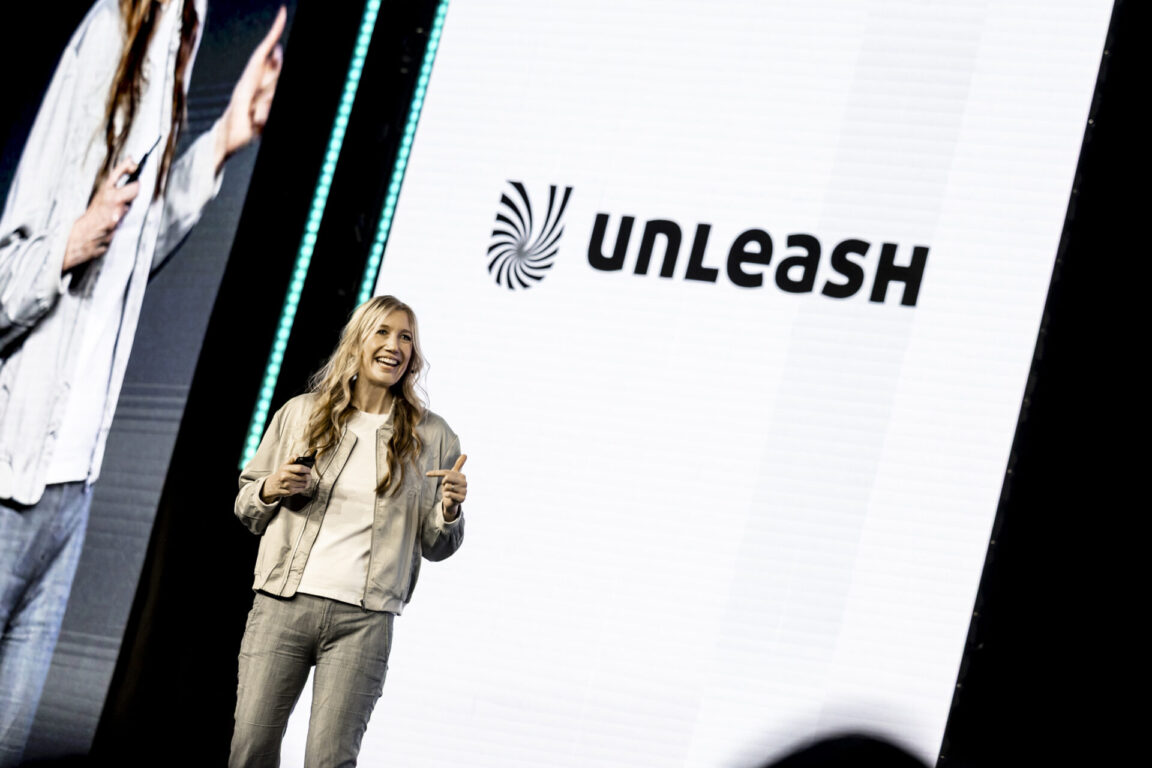
Jaime Teevan speaking on the UNLEASH America Main Stage.
Why HR has the opportunity and responsibility to drive AI success
Shifting from individual to collective efficiency with AI is much easier said than done – and Teevan acknowledges this.
The issue currently is that “everything we do as individuals has externalities,” Teevan tells UNLEASH.
“Naive use of AI for our individual productivity can actually cause harm to group productivity,” she stated on the UNLEASH America Main Stage.
Teevan shares: “You can create a beautiful content very easily” but “it’s a lot harder for people to distinguish between what’s good content and bad content when it’s all so beautiful and well worded.”
This epitomises the concept of AI ‘workslop,’ where content produced with the help of AI may seem useful, but lacks substance.
It forces those receiving it to spend more time interpreting, correcting or redoing the work, counteracting gains the creator reaps from using AI in the first place.
BetterUp and Stanford data found that AI workslop caused $9 million in lost productive ever year.
Teevan notes: “The biggest thing I worry about is the extra work that can get created,” especially when this is happening at scale across enterprise organizations.
What is the solution?
As Teevan wrote in the welcome to Microsoft’s New Future of Work 2025 report, “we must design AI to support shared goals, group context and the norms of collaboration”.
Organizations need new AI models and systems because the current tools work better for individuals than they do for teams.
However, success with AI is “as much about the systems and processes as it is about the underlying technology,” Teevan tells UNLEASH.
Therefore, HR needs to re-design ways of working within their organizations, a fact HR industry analyst Josh Bersin also noted in his UNLEASH America keynote and exclusive interview.
For Teevan, “HR’s opportunity right now is to redesign processes so that goals, context and decisions are shared, not siloed.”
Teevan recommends that organizations and teams get clear not just on their goals and grounding context, but also on who is accountable for the outcomes AI produces.
She tells UNLEASH: “You can’t fundamentally hold the model responsible for what it does. Accountability lives with humans.” It’s HR’s job to define accountability processes.
Teevan calls for leaders to “model good behaviour” when talking about their use of AI, and their accountability for its outcomes.
“There’s a risk right now that when you share something that’s produced with AI people view that content as worse,” so organizations need to “create a safe space for people to share the ways that they’re using AI.”
However, HR and business leaders also need to make it clear that even though they are experimenting AI – and they don’t have all the answers – “that doesn’t mean I’m not responsible for the content.”
HR needs to focus on figuring out “the future we want.” While that’s a lofty ask, Teevan calls for HR leaders to see this opportunity as “fun.”
Children learn by playing because “it’s joyful.” Organizations must learn from this and allow people to “step back, play, have joy, and try things out.”
If they embrace the fun, organizations will get better results and move faster with AI compared with “intense pressure to just get things done”.
Teevan’s call to action for HR leaders is to truly seize the opportunity in front of them. “AI is already changing work”, but “it’s not something that is happening to us”; HR will be the function shaping the organizations that emerge, so Teevan requests “please do a good job”.