Three lessons in leadership from Jacinda Ardern
The Former Prime Minister of New Zealand took to the stage at EZRA Hosts in London. UNLEASH was in the audience; here are our top takeaways on the need to embrace a kind, yet strong, style of leadership (and how to do it).
Event Takeaways
Closing out EZRA Hosts in London was Jacinda Ardern, Prime of Minister of New Zealand from 2017 to 2023 (through a range of crises like terrorist attacks, a volcanic eruption and the COVID-19 pandemic).
UNLEASH was in attendance - here are our top lessons from Ardern's fireside with EZRA's Chief Innovation Officer Sinead Keenan.
Jacinda Ardern redefined what successful leadership looks like when she was Prime Minister of New Zealand from 2017 to 2023.
She led the Pacific island nation through multiple crises, notably the Christchurch terrorist attack, a volcanic eruption and the COVID-19 pandemic, by leaning into compassion and honesty.
She proved that kindness and strength can co-exist and that empathy is, in fact, a leader’s biggest strength.
UNLEASH recently attended coaching giant EZRA’S Hosts event in London all about power redefined, and Ardern closed out the show in a fireside chat with Ezra’s Chief Innovation Officer Sinead Keenan.
Here are our takeaways from Ardern’s session – what are the three top lessons for leaders?
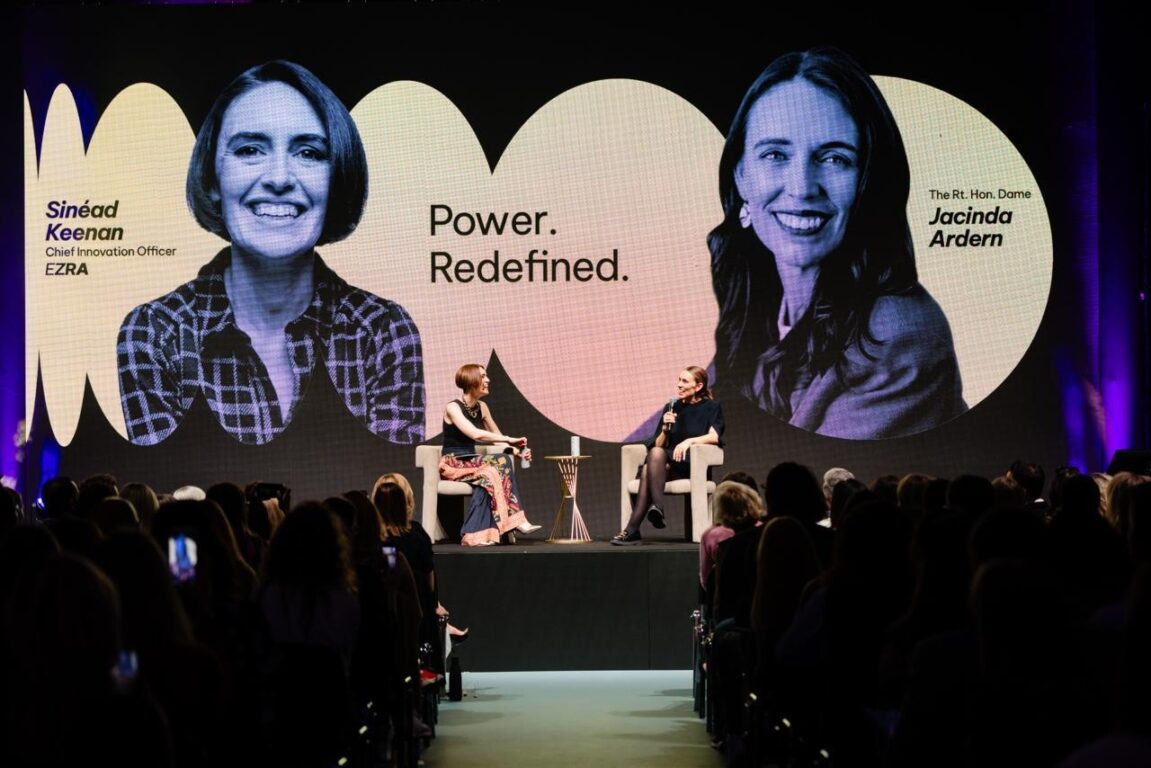
Credit: EZRA Coaching.
‘What you see as a weakness is probably a strength’
Ardern talked very openly about imposter syndrome she has felt in her career. While there’s no silver bullet to overcome this, she shared at EZRA Hosts that the key is challenging the idea that this is actually a weakness.
“My sensitivity was probably the first thing I had to confront” as a politician.
She tells a story of making a mistake when making a speech – sitting in the wrong seat – and getting ridiculed, and feeling upset by it.
She then went up to the toughest guy she knew in politics, and asked him how to toughen up? He said don’t do that, “you’ll lose your empathy”, and that is what will make you good at this job.
“My message would be, what you see as weakness is probably a strength, as long as you manage it.”
Ardern overturned her internal monologue of imposter syndrome through preparation and asking for advice – “isn’t humility and the willingness to seek the advice of others a good thing?”
You don’t need to have all the answers
The COVID-19 pandemic was a time when “people were looking for answers” – rather than saying, we have them all, this was the opportunity to challenge the old idea of leadership.
“It was obvious that we did not have all the answers”, and it was essential to be honest and acknowledge that.
However, that didn’t mean leaders cannot have a plan.
“Having a plan when people are afraid is really good – you cannot stand up and say, I don’t know what to do.”
This plays on takeaways from another keynote at EZRA Hosts, from Dr Haesun Moon from the University of Toronto. She asked the audience: How do you get people to think ‘I got you’?
Ardern’s message of challenging the idea that you can’t say ‘I don’t know’ is key to answering this question.
She went to talk about the expectation for very quick responses in the current, 24 hours news cycle we live in.
“Often the idea of solving a problem just means shutting it down”, and then everyone moves on – but that might not be the best answer.
We need leaders to be willing to say: I’m not going to make a quick decision on this, because that’s not the right thing to do.”
Leaders need “the ability to step back” outside of the news cycle and see the wood for the trees.
It takes “courage and bravery” to do that – it can create political “heat”, but often it leads to better, more evidence-based decisions.
Being optimistic isn’t naïve, it’s necessary
To close out Ardern’s fireside chat at EZRA Hosts, Keenan asked her advice to the next generation of leaders.
“Somehow, we have to maintain a sense of optimism,” shared Ardern.
She added that her childhood hero was Ernest Shackleton, the Antarctic explorer- “one of his sayings was that ‘optimism is true moral courage’” – it is a choice, and a courageous one at that.
Optimism is often seen as a negative, particularly in challenging times – they often say it is naïve, and suggested that someone is “not grounded in the real world”.
For Ardern, by contrast, optimism is “actually an expectation” – “I expect more of each of us. I expect that we need to fix these problems, and I hope that we will”.
“It’s crucial” because the opposite is indifference – how is that going to drive progress?