3 ways HR was reinvented at UNLEASH America 2026
The UNLEASH Editorial team was on-site in Las Vegas last week. Our Chief Reporter, Allie Nawrat, shares her key learnings from the show.
UNLEASH America 2026
The curtains have closed on an amazing UNLEASH America. HR was reinvented in Las Vegas last week.
This was our Chief Reporter, Allie Nawrat's ninth UNLEASH show. What did she learn from our incredible line up of speakers?
Read on to find out - and make sure to join us in Paris for UNLEASH 2026 this October.
HR was truly reinvented last week at UNLEASH America in fabulous Las Vegas.
Over the three day show, the UNLEASH team welcomed hundreds of speakers to discuss why AI presents huge opportunities for the HR function.
AI and HR took center stage at the Day One summits, CHRO panels, breakouts, and Main Stage keynotes from Harvard’s Amy Edmondson, The Wharton School’s Ethan Mollick, Josh Bersin, Peter Hinssen and Microsoft Chief Scientist Jaime Teevan.
Let’s dig into why our speakers believe AI presents a reinvention opportunity for the HR function – here are three quotes that tell that HR reimagination story.
Feeling the FOMO? Make sure you join us in Paris for UNLEASH 2026 – you can grab a pass now.
Ethan Mollick: ‘Your R&D team is HR’
The Wharton School’s Ethan Mollick is one of the leading AI thinkers in the world – he took to the Main Stage at UNLEASH America and declared: “Nobody knows anything. We’re all imposters. We’re all making it up as we go along.”
While this may not be the most comforting message for HR leaders, it is good news for their agency in the AI age.
Mollick views HR as the R&D team of the organization; HR can build a better world of work, leaders just need to decide to do it.
“The people in your organization are going to be the ones who figure out how to use AI to do things” – this is not an IT problem, vendors don’t have all the answers, so the “locus of innovation has to be inside the organization itself.”
According to Mollick, the most successful organizations at AI give teams impossible tasks, and see how far they get: “If they fail, it’s a learning for everybody.”
Embracing (and learning from) failure was the core premise of Harvard Business School’s Amy Edmondson’s opening keynote at the Las Vegas show.
“I’ve been studying failure for 30 years” and “our intuition about failure fails us.” Intellectually, we all know that failure is good as it leads to learning, but deep down emotionally, it is hard to accept mistakes.
Unless we align our emotions with our intellect and help our employees do the same, we will not thrive, we will not unleash the talent we need to unleash.”
This becomes even more important in the times of uncertainty; “in uncertain and challenging times, failure is more likely than ever, and innovation is more necessary than ever,” stated Edmondson.
Of course, “there are failures we should work hard to prevent, and then there are other kinds of failures we must learn to love.” The latter are called intelligent failures, which Edmondson defined as “the undesired result of a highly thoughtful foray into new territory.”
HR’s role is to spread to the word across the organization that “the only way to make progress is through trail and failure.” Not taking risks and staying in safe territory will not work in the future of work.
“I cannot promise if you take the time to learn from failures they will all turn into blockbusters, but I can promise you that if you don’t, they won’t,” added Edmondson.
Her recipe for excellence in an uncertain world is to aim high, team up, fail well, learn fast and repeat: “The cycle never stops.”
Peter Hinssen: ‘AI-first doesn’t mean people last’
Thriving through uncertainty was also the main topic of Peter Hinssen’s keynote address.
We’re living through “the craziest rollercoaster ride in the world of technology, in the world of work, in the world of HR” – and that creates “an enormous amount of anxiety.”
The uncertainty is going nowhere; we live in what Hinssen calls the ‘Never Normal.’
He asked the HR leaders in the audience: “Are you prepared for a world where disruption becomes the norm, where the waves get higher?”
Instead of fearing the disruption, can we use it to our advantage?
“I’m here to reassure you humans are still the best, low cost, all purpose non-linear computer systems that can be mass produced by unskilled labor” – this means “we’re living in a world now where AI-first doesn’t mean people last,” and this is where HR must come in.
Stop trying to use yesterday’s logic to do today’s work – companies are full of what Hinssen calls ‘yesterwork’, and HR needs to become “yesterwork hunters in the age of the ‘Never Normal’.”
Hoping that things will get easier is “a really bad idea…courage isn’t reacting to change, courage is shaping the future before it arrives.” HR and organizations have to learn to love uncertainty.
Industry analyst Josh Bersin agreed in his keynote that the word to define technology, and HR as a function, at the moment is “confusion.”
He argued that “the value of HR is how much productivity and growth can you create in the rest of the company, not how much can you ring out the cost of HR itself.”
In this world, organizations need to real that “the real impact of AI not just coming up with a great idea and giving everybody a bunch of tools, but bringing leadership along with you.”
“We’re in a world where you have to think about these architectural issues and focusing on the big problems where you can see a real return on investment.” It’s time to transform business processes and business areas within companies.
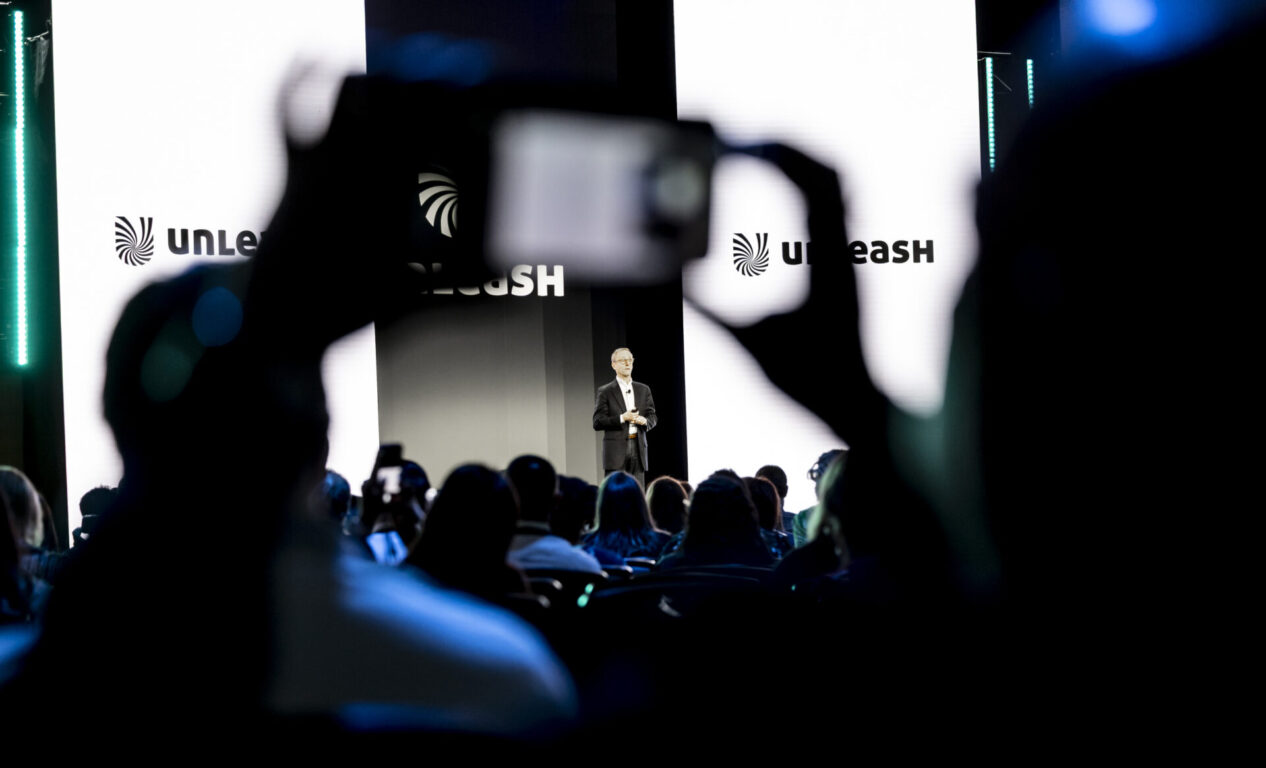
Josh Bersin speaking on the Main Stage of UNLEASH America 2026
MetLife CHRO Shurawl Sibblies: ‘We’ll look back on this moment as one of the most transformative times in our careers’
In these times of uncertainty, “it’s easy to want to hide or pretend you have the answers,” but that’s not the right approach; your employees will see right thought that, stated MetLife CHRO Shurawl Sibblies on the CHRO panel.
She continued: “This moment puts a premium on being authentic” – leaders need to show their employers that they too are in “learn mode”.
However, this does not mean doing nothing; actions need to taken, but the important thing is that HR brings employees along on the journey.
“I really hope people can leverage this moment not to be in fear of what can happen, but to be embracing what is possible” – “it’s not always fun”, but as HR leaders, “we’ll look back on this moment as one of the most transformative times in our careers.”
Adam Holton, Chief People Officer of GE HealthCare, called HR leaders “heroes” of this AI story, while Cardinal Group Chief People Officer Peter Lynch added that despite the pressure, AI presents an opportunity for HR to “capture the flag.”
Lynch himself has stepped into the CTO role at Cardinal in the past year and he believes that other HR leaders should take a similar approach, or at least be a “chief technology advocate” in their organization.
“Why is HR the right group to lead technology? Because we have the right mindset.”
Jaime Teevan, Chief Scientist & Technical Fellow at Microsoft, is also very clear that HR needs to be at the forefront of enterprise AI transformation.
Every time work has changed, HR has been responsible for reinventing how people coordinate” – “AI is already changing work, but you are going to shape the organizations that emerge, so please do a good job”, concluded Teevan.
Remember, we’re currently living through the first “baby step” in the AI transition, but the key thing to remember is that this transformation isn’t happening to us.
Speaking directly to the HR leaders in the room, Teevan is clear: “It’s something you actively control; you have the power to build the future.”