3 things leaders need to know from McLean’s HR Trends 2026 report
UNLEASH read the full McLean & Company HR Trends 2026 research – it found that organizational success depends on HR’s influence. Here’s how HR leaders can move the needle on AI, innovation, cross-functional collaboration and learning in 2026.
2026 In Focus
McLean & Company has published its HR Trends 2026 report.
Based on surveys with 1,600 leaders across the world, the research is full of practical advice on how HR teams can get ahead in 2026.
UNLEASH dug into the report - here are three things HR teams to pay attention to in the new year.
Every year, HR research and advisory firm McLean & Company publishes its HR Trends report.
The aim of the research is to cut through the noise, and provide practical advice that positions HR leaders to truly drive organizational success now and into the future.
UNLEASH took a deep dive into the 2026 iteration of the McLean research, which surveyed 1,600 HR and business leaders from across the world.
The data is clear that organization’s success in 2026 will depend on the strength of HR’s influence.
As a result, the function needs to stop following, and instead become a proactive leader and stabilizing force in this era of constant change.
That’s the top takeaway of the report, but what are the top three lessons HR needs to learn from this report? Let’s dig in.
1. Innovation becomes a top priority for HR
William Howard, Practice Lead, HR Trends & AI, at McLean & Company, tells UNLEASH that the most surprising finding of this year’s HR Trends report is that there has been “a clear shift in how organizations are thinking about what matters most”.
Howard adds: “Innovation has moved from tenth place in 2025 to second in 2026, while controlling costs has dropped as a top priority.
Together, those changes point to a growing understanding that getting through ongoing disruption isn’t just about cutting costs, it’s about investing in people.”
Unsurprisingly, the main reason why innovation has surged to HR’s second top priority is AI, and its rapid disruption of the world of work.
While organizations are making strides in AI maturity, there’s more work to be done by HR teams – just 37% of HR organizations are highly effective at enabling the adoption of new technology, and only 14% have an AI strategy.
To truly reap the rewards of AI, McLean & Company finds that HR needs to lean into supporting change management – “innovation and change are two sides of the same coin”.
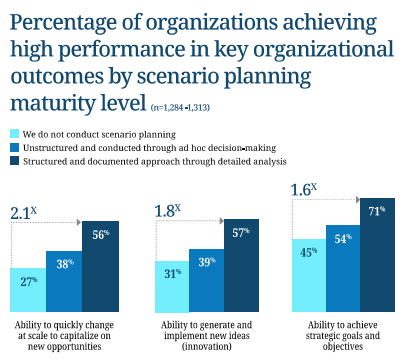
When HR is successful at this, organizations are 2.3x more likely to see high performance and 38% less likely to agree that change fatigue is negatively impacting people’s ability to do their jobs.
Currently only 41% of HR functions are highly effective at managing change and uncertainty – to move the needle, McLean calls on HR to “initiate scenario planning now”.
This is no longer an optional approach – the key is not to worry about being perfect, and to start small – “when it comes to planning for future disruption, doing something is better than doing nothing at all”, noted the report.
Credit: McLean & Company.
2. Cross-functional collab is ‘non-negotiable’
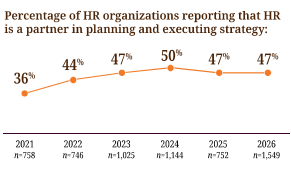
McLean & Company finds that HR’s strategic influence has stalled over the last few years.
Credit: McLean & Company.
To regain strategic ground, the report calls on HR teams to lean into collaboration with other departments – whether that’s Legal, Finance, Communications or IT.
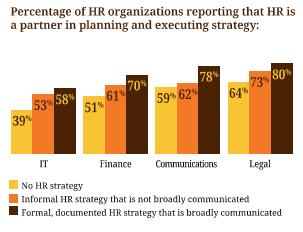
“HR’s strategic influence is grounded in collaboration” – McLean’s data shows that when HR is a partner in planning and executing business strategy, organizations are 3.2x more likely to be highly strategic.
HR’s partnership with IT is particularly important, given the AI-powered world of work – McLean refers to it as “non-negotiable” and is clear that both departments are “stronger together”.
When HR and IT work together effectively, organizations are 1.8x more likely to be better at innovation. This is because without the collaboration, IT risk overlooking the people impact of AI and therefore faces huge people barriers to adoption.
The issue is that while some organizations have made headlines for HR and IT’s partnership – notably pharma giant Moderna – only 55% of organizations are doing a good job here.
Success comes from HR having a clear People strategy (and communicating it to the rest of the business) – this connects HR’s work to shared goals.
Credit: McLean & Company.
However, McLean’s report also noted that HR also needs to learn the skill of talking to other departments in their own language.
Ultimately, as McLean’s Howard tells UNLEASH, HR faces a huge opportunity in 2026: “The organizations that invest intentionally in their leaders and people will be the ones best positioned to turn AI and innovation into real performance gains.”
3. Learning cannot be just a nice to have; it must be a strategic imperative
Innovation may have scaled HR’s priority list for 2026, but the top spot remains the same from 2025. Leadership development is HR’s number one priority in 2026.
As the pace of change continues to accelerate year-on-year, organizations expect more and more of leaders.
Leaders are being stretched thin, they are burnt out – McLean’s data found that leaders are 1.4x more likely than individual contributors to report higher level of stress today than a year ago.
When time is limited, it is easy for leaders to focus on what feels urgent: operational firefighting. The result? The people side of leadership is neglected,” stated the report.
This is a major problem as the data shows that leaders drive innovation and are an essential part of keeping turnover low, which is a key business need amid a talent shortage.
Currently, just 35% of organizations are doing a good job at developing leaders. The issue is that leadership development is often positioned as “optional” – this means “it consistently loses out to more urgent demands”.
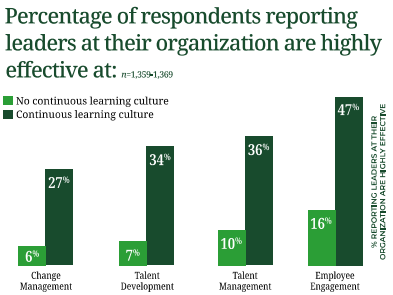
What’s the solution? For McLean, it is about embracing a continuous learning culture that puts leadership development as at truly strategic priority.
Credit: McLean & Company.
HR, “it’s time to build a culture of learning systematically rather than hoping it happens organically”. You don’t need to do it alone, lean into those cross-functional partnership and the C-Suite to truly set learning as an organizational priority.