3 things HR needs to know from McKinsey’s HR Monitor 2025
UNLEASH delved into the full McKinsey HR Monitor 2025 report – here are our top takeaways for global HR leaders on AI, skills, hiring and employee experience.
Research Insight
The time to modernize HR is now.
That's the conclusion of McKinsey's HR Monitor 2025 research, which focuses on the European HR market.
Here are our three top takeaways from the report on actions HR need to take to become a more strategic business partner.
“The gap is widening between what is needed from an efficient, effective HR function and what most organizations currently offer” – that’s the top line finding of McKinsey & Company’s HR Monitor 2025 research.
McKinsey surveyed 1,925 companies and 4,000 employees across Europe and the US to act as benchmark for the HR sector.
It’s clear that HR functions are aware of this reality, and are making changes.
Unfortunately, many HR departments “are still in the early stages of adopting best practice” around AI, workforce planning, learning and development (L&D) and skills.
For McKinsey, “now is the time to secure the necessary resources to modernize HR”.
“To ensure HR can continue to contribute to both the employee experience and the organization’s overall performance, leaders must align HR strategy with business priorities, strengthen the HR operating model, and build digital skills,” stated the report.
The question that remains is where should HR leaders start?
UNLEASH dug into the full McKinsey research to uncover three top takeaways for HR leaders who want to become truly modern, strategic partners for their companies.
1. Skills gaps are not a future concern, they are a reality now
Technological disruption has dramatically shifted the skills landscape for organizations – and they are struggling to keep with new and emerging skills.
HR leaders told McKinsey that 32% of employees do not have the skills they need to perform in their current roles, while Korn Ferry research suggest that the global shortage of skilled workers could reach 85 million by 2030.
The problem is especially acute for critical skills, like problem solving, data analytics and AI; these are in high demand, but short supply, particularly in Europe.
Only 21% of European employees have received generative AI training, compared to 45% in the US.
An issue is that while HR leaders have skills taxonomies (77%), and are documenting employees skills in their HR systems (93%), they are not truly leveraging this skills information to do long-term strategic workforce planning.
73% of HR said are doing short-term operational workforce planning, but this drops to 9% who are doing truly strategic workforce planning with a view over the next three to five years.
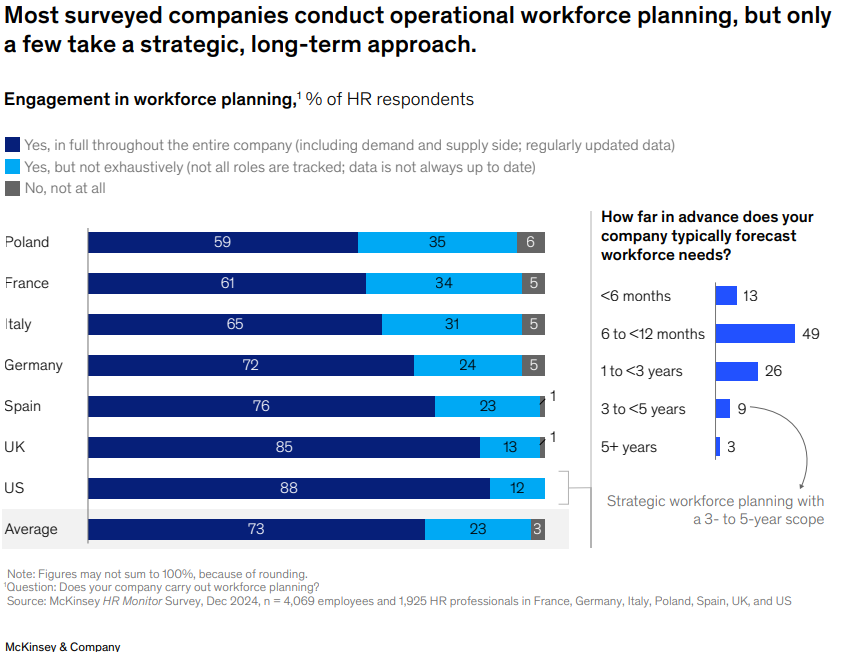
Plus, just three in ten of those doing workforce planning and comprehensive skills documentation are integrating skills data into their strategic workforce planning.
It’s high time that HR shifts away from headcount to having skills-based strategy that focuses on current and future talent needs.
For McKinsey, AI has a huge role to play here, as it can help HR gain real-time workforce insights and do better scenario planning.
2. HR AI adoption needs to revolve around ROI
On the topic of AI, McKinsey’s data found that just 36% of European organizations are regularly using AI, compared to 76% in the US.
HR functions see the potential of AI, with 91% believing that their department will be affected by generative AI in some way, and six in ten organizations having either implemented, or have a plan to implement, AI governance.
The issue is that currently European HR leaders are implementing generative AI in routine HR tasks, like time tracking and absence management (23%), administration of employee data (21%) and automation of repetitive administrative tasks (21%).
Instead, they need to be focused on the return on investment (ROI) on AI – and ensure that that they are using AI for high-value applications, not just scattered low impact use cases.
Currently, just 19% of core HR processes in Europe are being enhanced by generative AI.
If HR teams can improve their use of automation of AI and automaton, they can “increase speed, scalability, and strategic impact”.
3. Don’t assume you know what keeps employees in their jobs
Two in ten employees told McKinsey they are actively dissatisfied with their employer, and employees are missing 15% of assigned worktime, around 37 working days a year, due to absence.
By contrast, only 7% are considering quitting their jobs.
While low attrition is good news, disengagement is always a risk for organizations. It seems that ‘quiet quitting’ is rearing its head in 2025 as the labor market switches back to being in employers’ favor.
The challenge for HR leaders is that there a disconnect between their efforts to drive up engagement and why employees actually stay in their jobs.
HR is focused on compensation (41%), work-life balance (38%), job security (32%), flexibility (30%), and learning and development (25%), while employees have a different order of priority.
Top of mind for employees are job security (39%) and work-life balance (34%) – HR has completely missed how important relationships withs colleagues are to employees, coming in at number three (33%).
For employees, compensation was only in fifth place with 28%.
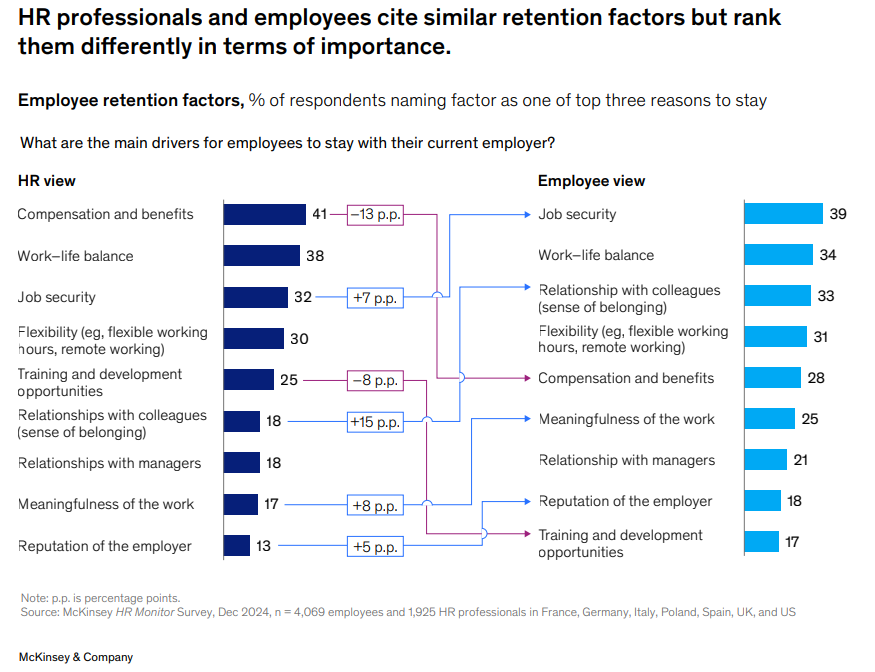
It’s clearly time for HR teams to align employee experience “with what employees truly value, organizations can boost engagement and retention—even in times of uncertainty”.
McKinsey’s data also suggested there’s a need for HR teams to be better at listening to the needs of candidates in the hiring process.
Currently, hiring success in Europe sits at just 46%, with just 56% of candidates accepting an offer and 18% of new hires leaving in probation periods.
With candidates, HR focus primarily on compensation and benefits and flexibility, while learning and development opportunities (28%), relationships with managers (26%), meaningfulness of work (23%) and reputation of the employer (19%) were also important to job seekers.
There’s lots of food for thoughts for HR leaders here in Europe from the McKinsey report – are you ready to make a change?