Performance edges ahead of engagement with HR facing ‘biggest opportunities and challenges today’: Lattice
HR workers around the world are focused on performance in 2026 and excited about agentic AI, but headwinds persist and many younger professionals are considering departing the profession, according to the 2026 State of People Strategy Report from Lattice.
News in Brief
Performance has topped the priority list for HR professionals around the world going into next year, according to Lattice’s 2026 State of People Strategy Report.
Despite enthusiasm for a future fueled by the power of agentic AI, younger HR workers are most at risk of leaving the profession.
UNLEASH got the inside track on this year’s report from Lattice VP of People, Sophie Hurcombe, who examines what HR leaders need to know from this year’s report.
Employee performance has edged ahead of engagement as HR’s top priority for the first time in six years going into 2026, according to the latest State of People Strategy Report from employee experience tech specialist, Lattice.
In a continuation of trends noted in the 2023, 2024 and 2025 iterations of the report, performance management (40%), employee engagement (39%), learning and development (31%), and manager enablement (30%) were found as the top priorities for HR in the year ahead.
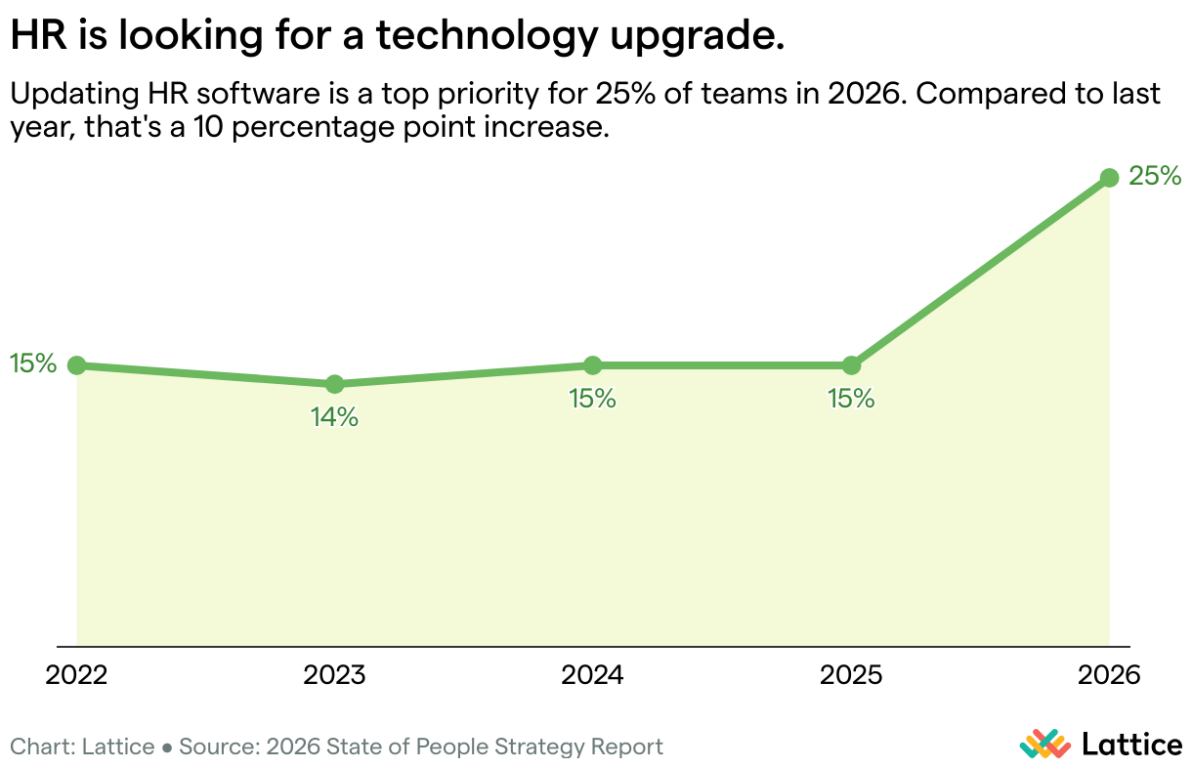
As AI takes a greater hold on the workplace and organizational strategy, updating HR tech was also cited as a priority by 25% of respondents for next year.
Meanwhile, DEIB prioritization stayed stagnant at 16% (down from 29%) as revised government and corporate policies came into effect.
Lattice noted that high-performing teams are those that understand and foster the link between performance and inclusivity via DEIB initiatives.
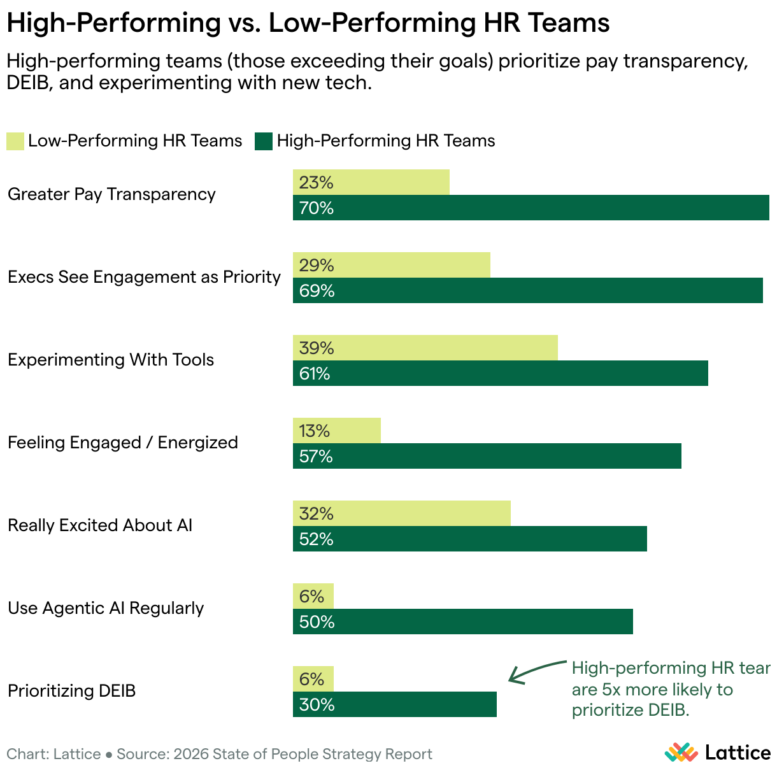
While performance and DEIB have taken inverse paths of prioritization in recent years, the report found that high-performing teams are five-times more likely to prioritize DEIB and use agentic AI compared against low-performing teams.
Speaking exclusively to UNLEASH, Lattice VP of People Sophie Hurcombe says this “nuanced shift” is also a reflection of today’s business realities.
“Businesses – and HR teams by extension – have experienced incredible change and volatility in recent years,” she explains.
“We’re now seeing a stabilization and a return to core strategies that drive strong results. This includes planning and goal setting, regular performance check-ins, driving engagement, and effective talent management.
The savviest people leaders are eyeing innovative HR and AI technologies that help support them in this work.”
HR are faced with ‘some of the biggest opportunities and challenges today’
This year’s State of People Strategy Report found that HR teams expect to be “pulled in every conceivable direction” going forwards, as they “try to defend their programs, prove the ROI of people strategy and traverse the deepening fault lines of workplace polarization”.
Hurcombe tells UNLEASH that the 2026 report finds HR leaders and teams “at the center of some of businesses’ biggest opportunities and challenges today – a notable return to performance management, AI innovation, and maintaining engagement with leaner budgets.”
However, HR leaders are also faced with “navigating an increasingly divided workplace”, she adds, highlighting findings that show 23% are managing “cultural and political polarization” and 32% who feel “stuck managing the perceptions of employees and leaders who don’t see eye-to-eye on DEIB.”
“Naturally, this would take an emotional toll,” Hurcombe says.
Lattice found that 41% of HR professionals surveyed had thought about leaving the profession, of which 9% are still considering departing.
While the good news is that the remaining 59% hadn’t considered leaving and 32% thought about it but decided to stay, 68% of low-performing HR professionals have considered leaving the profession.
Hurcombe comments that of those that considered leaving HR, a majority remain “engaged and are looking to use this moment to upskill on AI and new technologies to tackle these pain points and scale their functions.”
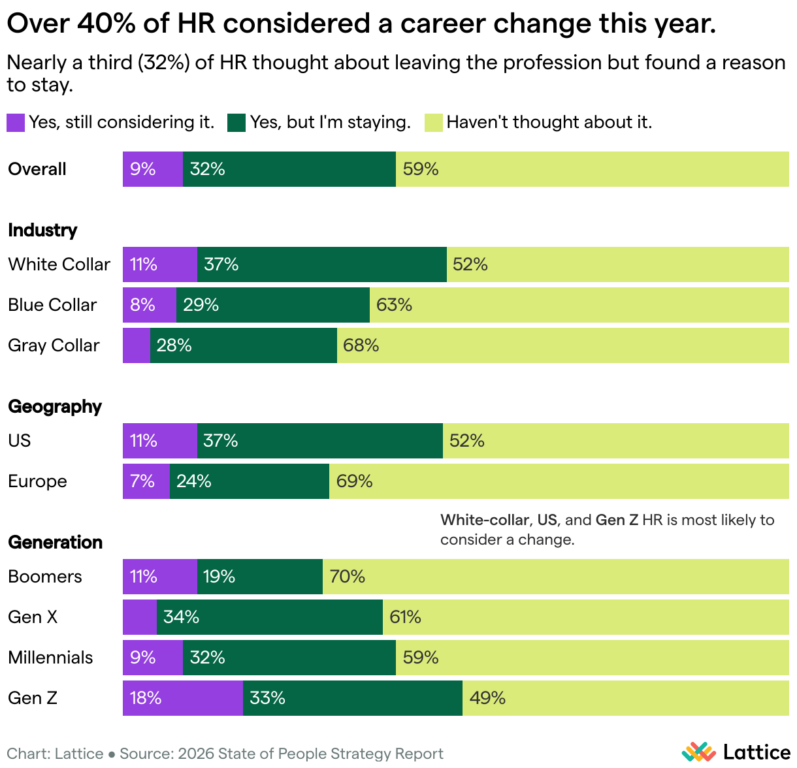
Worryingly, it is the younger HR professionals that are most likely to be considering an exit. Just over half (51%) of Gen Z surveyed said they had considered leaving the profession, with 18% still thinking about it and 33% electing to stay put.
The report showed that Gen Z respondents are struggling with smaller HR teams as a result of downsizing in recent years, while Millennial HR workers are struggling with the emotional toll of managing employee issues.
Despite this, Hurcombe says there is “also innovation and optimism” among HR workers, with more than half of high-performing teams excited about how AI will transform the HR function.
“So, I’d recommend younger HR professionals upskill and explore how AI can help manage their workload, eliminate routine and unengaging tasks, and scale (not replace) the human touch”, she says.
“After all, the HR function keeps people at the heart of everything we do. No one is better positioned to lead this effort than HR professionals. I hope this inspires our younger generations entering the field.”
The HR technology paradox: Maintain performance but consolidate stacks
With a stricter focus on budgets, Lattice found that more than half (55%) of HR terms are facing technology stack consolidation. At the same time, 25% of teams highlighted updating their technology infrastructure as a priority for 2026.
The report found 72% of high-performing teams are using four or more HR tools, with nearly half (49%) using six or more.
Overall HR respondents are likely to use three tools but Lattice highlighted that high-performing teams are more likely to use specialized tools across operations such as performance management, applicant tracking, compensation and payroll, learning and development, and time tracking.
“This offers an opportunity to revisit systems and tools, evaluate what’s working or not, and renew focus on ROI,” says Hurcombe.
“So the question goes beyond consolidation, rather it is: How do we find the right technology that offers the right solutions to keep our employees performing, engaged, and innovating?
“In short, what technologies will help make work meaningful?”
The 2025 edition of the report found that AI implementation had stalled among HR departments, but the emergence of agentic AI has moved workers from generation via prompt to more proactive automation.
Just under half (42%) of HR professionals in corporate or white-collar organizations say they have experimented with or use AI agents regularly, especially in Europe (45%) compared to the US (28%).
Hurcombe tells UNLEASH that the report reinforces “what we know to be true” about the confluence between AI and human workers: “AI gives us superpowers and enhances our work, so long as people remain at the center.
“Overall, 83% of HR professionals are excited, hopeful, or optimistic about outsourcing busywork and more manual tasks to agentic AI,” Hurcombe concludes.
From removing busywork to org design to gaining more effective management skills, there’s a massive opportunity in what people and AI can do together. I strongly believe this is the future of work.”