Gartner: 4 key priorities for CHROs in 2026 to lead the AI-driven future of work
What is top of your priority list for 2026? According to new research from Gartner, HR leaders will be harnessing AI, shaping work in the AI era, mobilizing leaders for growth and addressing culture issues.
Research Insights
CHROs will be focused on harnessing AI, shaping work in the AI era, mobilizing leaders for growth and addressing culture issues going into 2026.
That’s according to the latest research from Gartner.
UNLEASH sits down with Mark Whittle, Vice President of Advisory in the Gartner HR practice, to find out more.
The future of HR is rapidly shifting as AI shifts how work is done and emerges as an increasingly perceived viable alternative to the roles currently fulfilled by human talent.
As a result, CHROs looking to the future need to ensure other leaders within their organizations are prepared to lead towards a growth and efficiency mindset, while also addressing rising expectations for employees to do more with less.
That’s according to new research insights from Gartner, which identified four key priorities for CHROs in 2026: Harnessing AI to revolutionize HR, shaping work in the human-machine era, mobilizing leaders for growth in an uncertain world, and addressing culture atrophy to power performance.
UNLEASH speaks exclusively with Mark Whittle, Vice President of Advisory in the Gartner HR practice, to delve into these trends and what they mean for HR leaders as they face the coming year head on.
HR is in line for an AI revolution but CHROs must be leaders
As CEOs bet on AI as a driver of growth, it is becoming ever more imperative for CHROs to be at the forefront of driving AI strategies that intersect with talent and the HR function.
A significant part of this is to build executive alignment on the people-related topics that other business leaders may not consider, Whittle explains, such as skill gaps within the organization and the implications of using AI to fill those gaps.
Meanwhile, agentic AI may involve changes to the Employee Value Propositions (EVP), impacting on factors such as career paths and opportunities, he adds, as more tasks and skills are turned over to these agents.
“Finally, you’ve got to think about talent pipelines: What does that do in conjunction with careers? You may end up having pipelines that are empty or short because you haven’t really been developing those people,” he tells UNLEASH.
“Those are the things a CHRO can bring to the table that aren’t necessarily ones others think about, sort of the flotsam left behind by this wave of AI that maybe some of the other C-Suite folks are charging ahead with.”
While there is significant potential for the AI-powered future of work, evidence suggests that it is still early days for most organizations.
In these instances, CHROs need to make sure they are aware these conversations are taking place within their organizations and “make sure that they’re there to have a voice,” Whittle says.
Develop strategies now for the next era of work
In order to lead organizations through the human-machine era of work, CHRO’s need to develop a “now-next” talent strategy, Gartner found.
This clearly demonstrates how to maximize talent in the next 12 months, then driving better talent outcomes over the next one to three years.
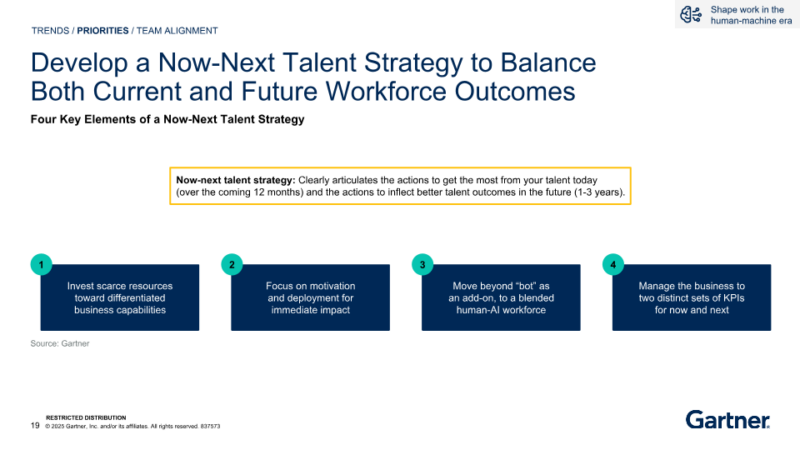
CHROs that are already on the right track with their AI strategies will already be making CEOs and other C-Suite colleagues about issues like fractured career paths and threatened talent pipelines, Whittle explains.
“It’s already a big win understanding that you’ve got different employee segments, and the impact is understanding what this may mean for our skills, “he comments.
“Many CHROs and HR departments are doing something with AI in their function and trying to enable AI within their organizations. It’s mostly trying things out, piloting a few things and implementing a few things, but you’ve got to have a real plan first, with a framework to think of.”
However, he also wants that CHROs shouldn’t just be thinking about AI.
There’s other technology out there and sometimes we get so focused just on the AI piece, that we forget that humans are still really important,” Whittle adds.
Empowering leadership skills and revitalizing culture will be crucial
Indeed, leading through periods of change and uncertainty has always been a necessary trait for business and HR leaders alike, but in an AI-embedded world that is becoming more crucial than ever before.
While employee engagement and performance are likely to be top priorities for HR leaders going into 2026, Whittle highlights that CEOs will be more focused on achieving both growth and efficiency at the same time.
“It’s the working of both of those muscles at the same time, growth and efficiency, that makes it tricky. Organizations need to mobilize leaders’ growth in an uncertain world, there is a need to depend on leaders to realize this growth-efficiency,” he explains.
Although AI and technology have certainly played a big part in driving growth and efficiency, he adds that “it’s leaders that have to lead, that need to see their main roles as mobilizing and transforming the organization.”
In this operating environment, it will also be critical for CHROs to ‘routinize’ change, particularly when that change has become ‘ungovernable’.
“There’s no beginning, middle or end changes; it’s not just more complex, it’s interdependent and a lot more externally driven,” Whittle explains.
This complexity, consistency and volume of change may leave some leaders feeling they have “to be at max intensity all the time”
To combat this, Whittle says CHROs need to train for change – similarly to how tennis players practice their swing until it’s perfect – to ensure that focus remains on the moving end objective, as well as help employees surface how they feel about change and train their intuition “to go and change reflexes into their daily work.”
Ultimately, HR leaders need to see these trends coming, Whittle says, and to recognize that 2026 is a “big opportunity for HR and for CHROs.”
“Don’t let the organization pin HR into a corner as just a function, because when things are uncertain, double down on what you know, which is functional, efficiency and effectiveness”, he concludes.
You’ve got to stay energized, see this as an opportunity and be open. You have to really double down on becoming a digital leader and learning.”