Organizational readiness, not employee resistance to change, is the biggest barrier to AI success
That’s the top line conclusion of two new reports – one from Qualtrics, the other from Celonis. UNLEASH speaks to executives from the two tech giants to find out what actions people leaders need to take in response to move the needle on AI ROI.
Research Insight
Leaders and employees are on board with AI - they aren't scared of change, and they see the AI benefits for themselves as individuals, but also for organizations.
However, organizational processes are struggling to keep up and are not managing the AI change well.
That's according to two new research reports from Qualtrics and Celonis. UNLEASH delves into the data, and talks to executives from the two tech companies to explore how to fix the AI readiness problem.
Change is the only constant in this age of uncertainty.
As UNLEASH America 2026 keynote Peter Hinssen shared in a recent exclusive interview: “I don’t think we’re ever going to have a normal” – instead, there will be a relentless, “continuous flow” of innovation and disruption.
Change and uncertainty is “not a storm” – “this is the climate” for businesses across the world.
The good news is that employees no longer see change as the enemy. That’s according to new data from experience giant, Qualtrics.
Qualtrics surveyed 34,000 workers in 24 countries and found that employees are on board with technological disruption.
As Qualtrics Chief Workplace Psychologist, Benjamin Granger, exclusively tells UNLEASH: “Our research shows that employees aren’t wilting under transformation. Actually, it’s the opposite, they’re energized by it”.
“Workers are well aware that the world is changing and if they feel stagnant in their organizations and jobs, it becomes abundantly clear that they’re being left behind,” he adds.
This is a big shift for organizations, and specifically HR leaders.
Employees are embracing AI in droves; Qualtrics found that 52% of workers are regularly using AI (up seven points from 2025), because they see the benefits of AI for them and their employers.
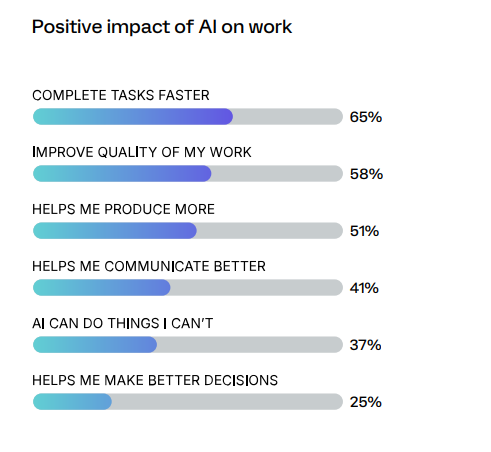
Credit: Qualtrics.
The problem is that one in three workers, according to the Qualtrics, are neutral about AI and still don’t see how it will change their work.
“If change isn’t the real threat, what is? Unmanaged change,” notes Granger.
These conclusions from Qualtrics align with recent research from data giant Celonis’ survey of 1,600 business leaders. Just 6% of leaders said resistance to change was the top hurdle to AI ROI – this means it ranks bottom among the AI hurdles.
The biggest barrier to enterprise AI success isn’t ambition or access to technology, it’s a lack of readiness”, adds Celonis SVP for North America, UKI & MEA Rupal Karia, when talking about Celonis’ findings.
This fact must be a wakeup call for leaders, in HR and beyond. The question that remains is: What actions do they need to take in response?
How to overcome readiness challenges and reap the AI ROI rewards
Leaders are excited about AI – 89% of leaders told Celonis that AI is their biggest opportunity to compete, 83% believe AI will deliver greater ROI in 2026 than in 2025, and 85% want to be so mature with AI that they can classify themselves as an ‘agentic enterprise’ in three years.
As a result, “leaders no longer need to decide whether to deploy AI, but how they’ll turn their AI ambitions into reality,” notes Karia.
“76% admit that their current processes are holding them back,” he adds.
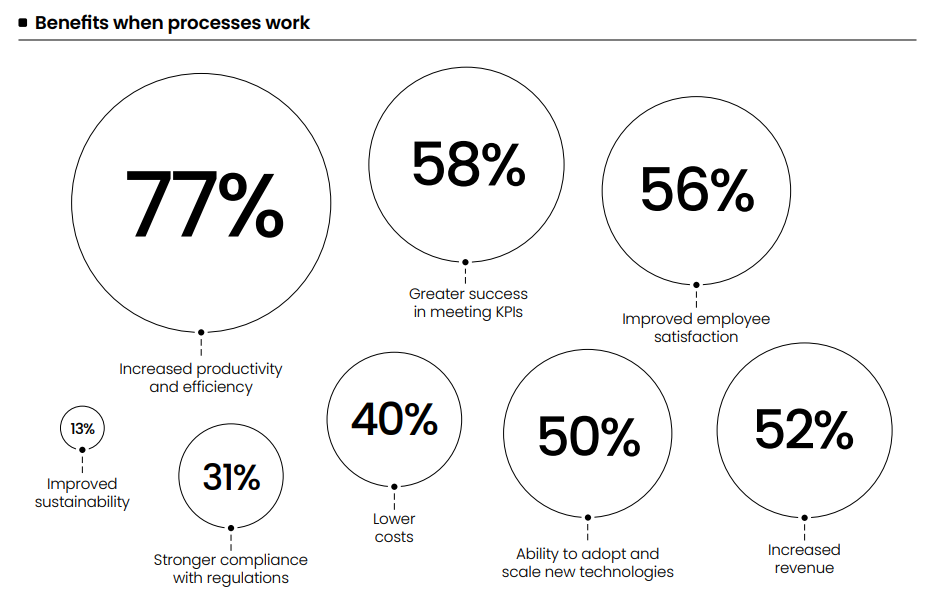
Credit: Celonis.
Nearly half (47%) said their top hurdle in adopting AI was lack of internal expertise, while 45% noted difficulties with getting AI to understand the business.
The organizational readiness challenge “is as much a people and skills challenge as it is an operational one,” continues Karia.
“HR no longer simply supports AI rollouts but actively shapes AI strategy and implementation”, which means “understanding new ways of working where AI is present and redesigning jobs and incentives around human-AI collocation,” adds Karia.
Granger from Qualtrics notes that HR and business leaders need to work together to figure out “where employees need to be supported, and what tools and changes help them to adapt and perform”.
Success with AI isn’t about doing more, but “doing what matters”.
To do this, businesses need to ground “transformation efforts in a clear, data-driven view of end-to-end processes” – these processes must be aligned with “workforce strategies that enable effective human-AI collaboration and ensure AI removes friction, delivering measurable value for both employees and the organization”.