Recognition and culture in times of change: Key takeaways from Workhuman Forum
Workhuman Forum took place in Paris ahead of this week’s UNLEASH World show – here are the key messages from the UNLEASH Editorial team.
UNLEASH World 2025
UNLEASH World 2025 kicked off in style, with a one-day, invite-only event designed for forward-thinking HR and business leaders, in partnership with Workhuman.
Workhuman Forum featured a stellar lineup of bold keynotes and tangible actions for HR leaders to return to their respective organizations with.
The UNLEASH Editorial team was in the room to bring you all the key takeaways.
The first Workhuman Forum to take place in Paris was the perfect way to kick off the UNLEASH World 2025 experience.
An exclusive, invite-only cohort of HR and business leaders packed out the room to hear a stellar lineup of HR experts tackle some of the biggest talking points of the moment and how to make work more human.
Above all, there was plenty for HR leaders in the audience to take back to their own organizations on the topic of employee recognition and the role of people in the era of AI.
As event emcee and global leadership expert, Holly Ransom, put it in her welcoming address: “The best and brightest HR and business leaders are meeting and working to write the future of work together.”
Here are the UNLEASH Editorial team’s key takeaways from the event:
Leading through change
First up on stage was Janina Kugel, former CHRO at Siemens, Senior Advisor and Author, who gave a rousing keynote address on leadership during times of change.
People leaders will be all too aware that there are numerous global drivers of change right now, but Kugel stressed to delegates that organizations cannot lose sight of their greatest assets: Their people.
During such times, it is incumbent on leaders to not only step up and “find the right path”, but to unite empathy and adaptability at the same time.
A significant part of this is interweaving culture and performance: “If culture goes wrong, that happens very quickly.
“We all know organizations where, within a year or two, things become different dramatically. But to actually improve culture and work on it, that takes a very long time.”
She also underlined the importance of managers and leaders providing opportunities for continuous learning, feedback and recognition – particularly practicing reflective recognition by asking employees what they believe they have achieved and how they got there.
At the same time, Kugel warned that “change means breaking with tradition”, often one of the most difficult things to do.
“If we want to embark into a new course, we need to rethink the structures, the ways that we’re thinking.”
It will mean there are a few things we have to break, a few things we have to readjust. We will never record anything new if we don’t let go of traditions.”
The power of recognition and culture
Then it was the turn of Workhuman CEO, Eric Mosley, who sat down for an in-depth chat with Ransom, covering the history and ethos of Workhuman, the critical role of data in the era of AI-powered work, and the power of recognition.
Detailing one of the “keys to success” since establishing the organization 25 years ago, Mosley explained that compiling messages of recognition among staff may seem like “pretty transactional or small” but are in reality “laden with insight.”
If you actually look at them over a long period of time, you’ll see that they describe what everyone in the company is doing and the effect that everybody is having on everybody else,” he said.
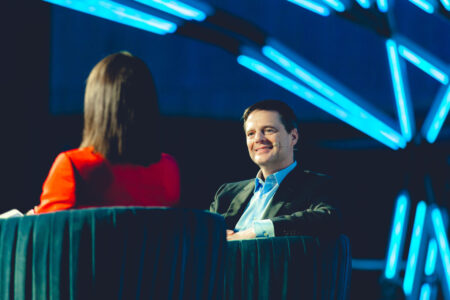
Workhuman CEO Eric Mosley in conversation with Holly Ransom
Following on from Kugel’s keynote on the topic of change, Mosley added that culture is “everything in business, because people are in business, and people stay in businesses because they’re a part of community”.
In the context of AI, Mosley explained that organizations cannot afford to think of the technology as an exponential differentiator – once AI tools become commoditized across markets and organizations, it will be people that are the difference.
He added that in the AI era, it will be the role of people leaders and CHROs to manage the “efficient deployment of skills, to marshal the company to place where AI is doing a lot of the early work”.
Following Mosley’s fireside chat, UNLEASH attended an exclusive media briefing held by Workhuman’s Chief Human Experience Officer, KeyAnna Schmiedl and President, Tom Libretto.
Libretto revisited Mosley’s points on how employee recognition messages can contain valuable data, providing insights as to how and where working is happening, what skills are being utilized across organizations, and more.
Natural language processing and AI can therefore help leaders to uncover patterns and connections that can be beneficial to the business.
“What we’re able to find with the application of that AI technology against that recognition data is a much more authentic and robust view of a person in an organization,” he said.
“For example, their contribution now, but importantly, what their contribution may look like into the future.
“So it’s got us really excited. It’s got our clients really excited, because it’s just another way to leverage the benefit of recognition.”
Schmiedl then took the floor, to explain the ever-evolving role of the CHRO, moving away from chasing policy completion to thinking about “what is the work that the business needs to have people doing in order for businesses to succeed.
“Now more than ever, we’re seeing that.”
Touching upon AI and HR merging, she concluded: “For me, it’s the idea that AI should be replacing work, not jobs.
It is our job to think about what the jobs of the future will be. That’s always going to involve a human. AI does work, it doesn’t do a job.”
Rethinking how work is done
After a buzzing networking break, Schmiedl and WSJ Leadership Institute’s President Alan Murray took to the stage for a fireside with Ransom.
Murray kicked off the conversation by talking about how value is becoming much more human-centered; this is elevating the position of the HR function, which is responsible for the people who create the value.
CEOs are excited about AI – the WSJ Leadership Institute includes specific councils for CEOs, CFOs, CIOs and CPOs – but their challenge (and frustration) is not the technology. The issue is getting people to lean into it – “how do I get them to understand the possibility and not be afraid of it”.
Schmiedl said the one thing she wanted to audience to takeaway from the panel session is to “stop having a conversation about what jobs AI is going to replace” – “let’s start having a conversation about what work AI should be doing”, and what work humans should be doing.
“It’s the biggest opportunity that we have had to completely rethink how work gets done,” adds Schmiedl.
Murray agrees. He adds: “If you simply view this as a cost-cutting opportunity to automate existing processes, you will lose the competitive AI race.”
He calls on leaders to be creative – it might not be what’s taught in business school, but in this AI-age, it is an essential human skill.
The importance of psychological safety
Harvard Business School Professor and author, Amy Edmondson, took to the stage to deliver the final keynote of the day.
“A fearless organization is an aspiration – they can take risks, learn, grow and succeed,” she opened. “But I don’t know a fearless organization.”
To overcome this, Edmondson highlighted that success in an uncertain world depends on high-quality bets. But high-quality bets depend on high-quality conversations.
These conversations don’t necessarily come from the people that speak the most or the loudest, but rather, ensuring everyone’s point of view is heard. To encourage this, organizations need to ensure they are psychologically safe.
Sharing her definition of psychological safety, Edmonson explains that it’s “a belief that the context is safe for interpersonal risks – the speaking up with ideas, questions, concerns, or mistakes will be welcomed and valued”.
She added: “Your job as a leader is to do what you can to create psychological safety. And to do this, you need to create candor.”
“With psychological safety, we can be more honest, we can be more candid and we can be more successful. But what’s holding us back?” she asked.
To answer her own question, she highlighted that it’s not having enough high-quality conversations. Low psychological safety is therefore the default, because employees often keep quiet to remain “safe”.
High-quality conversations don’t happen by accident. They take skill and leadership,” Edmonson noted.