AI is a people challenge, not a tech one: Here’s how to redesign work for the better, according to Workhuman & WSJ Leadership Institute
In exclusive interviews at Workhuman Forum on Day One of UNLEASH World 2025, KeyAnna Schmiedl, CHXO at Workhuman, and Alan Murray, President of the WSJ Leadership Institute, explore the crucial role that HR plays in this AI reality of work.
UNLEASH World | Expert Insights
HR must be in the middle of the AI conversation. That's the view of WSJ Leadership Institute President Alan Murray.
UNLEASH sat down with Murray, as well as KeyAnna Schmiedl, Workhuman CHXO, at Workhuman Forum in Paris.
Here's their insights into how organizations need to rethink the world of work in this age of AI.
This year, the Wall Street Journal (WSJ) Leadership Institute launched a new council.
Sitting alongside its CEO, COO, CMO, CFO membership councils, the new CPO Council was created in partnership with recognition technology giant Workhuman.
During a panel at Workhuman Forum on Day One of UNLEASH World 2025, Alan Murray, President of WSJ Leadership Institute, shared the reasoning behind opening a CPO Council now.
Fifty years ago, in the 1970s, 80% of value in Fortune 500 organizations was physical, but now it is tangibles – as a result, value within organizations has become much more human-centered.
Murray was joined on stage by KeyAnna Schmiedl, Chief Human Experience Officer at Workhuman, as well as event emcee Holly Ransom.
At Workhuman Live, UNLEASH had the opportunity to sit down with both Murray and Schmiedl to pick their brains about AI, HR and the future of work.
WSJ’s Alan Murray: HR must be in the middle of the AI conversation
Organizations need to realize that the AI challenge is a people one, not a technology one, Murray tells UNLEASH. He believes this fact is not getting the attention it deserves.
“The technology is going to take care of itself – it’s moving ahead at a head spinning pace.”
Instead, the challenge is “how do we create human organizations that can move fast enough to take advantage of that technology change” and “make the world a better place”.
This explains why Murray sees HR as having hugely important roles and responsibilities in this AI-powered world of work.
“HR needs to be in the middle of this conversation, particularly as the conversation has moved from generative to agentic AI,” Murray tells UNLEASH.
Murray notes that with agentic AI, “you’re talking about creating workers”, so HR teams need to think about “how do you create a culture that that can both embrace and productively adopt this technology – it’s not an easy thing to do”.
Then, “once you’ve done that, how do you incorporate technology agents into a workforce” of people.
“There’s a whole new line of practice that this opens up for people leaders” – and this is key to why the WSJ Leadership Institute decided 2025 was the time to create a CPO Council.
This reality is also a challenge for managers more generally – “now we’re talking about a team that’s not just dispersed, but it’s about made up of people and bots” – it’s no longer just about building, borrowing or buying talent, there is also the ability to ‘bot’ talent, Schmiedl tells UNLEASH.
She also shares that many have fallen into the trap of talking about AI replacing jobs – “I don’t think that’s right”.
Instead, there’s a need to focus on how AI is replacing work, and then rethinking about roles look like.
To redesign work, Schmiedl is clear that “we need to think more cross-functionally”.
“What AI does is show you how broken the org structure truly is.” Rather than relying on department structures that hark back to the Second World War, Schmiedl wants to see companies organizing around the strategic priorities of the business – almost like a center of excellence model.
Murray agrees – he tells UNLEASH: “The successful companies of the future are going to be those that build successful cross-functional teams.”
At Workhuman Forum, Murray was clear that organizations really need to see AI as not just an opportunity to automate, but a chance to truly redesign workflows.
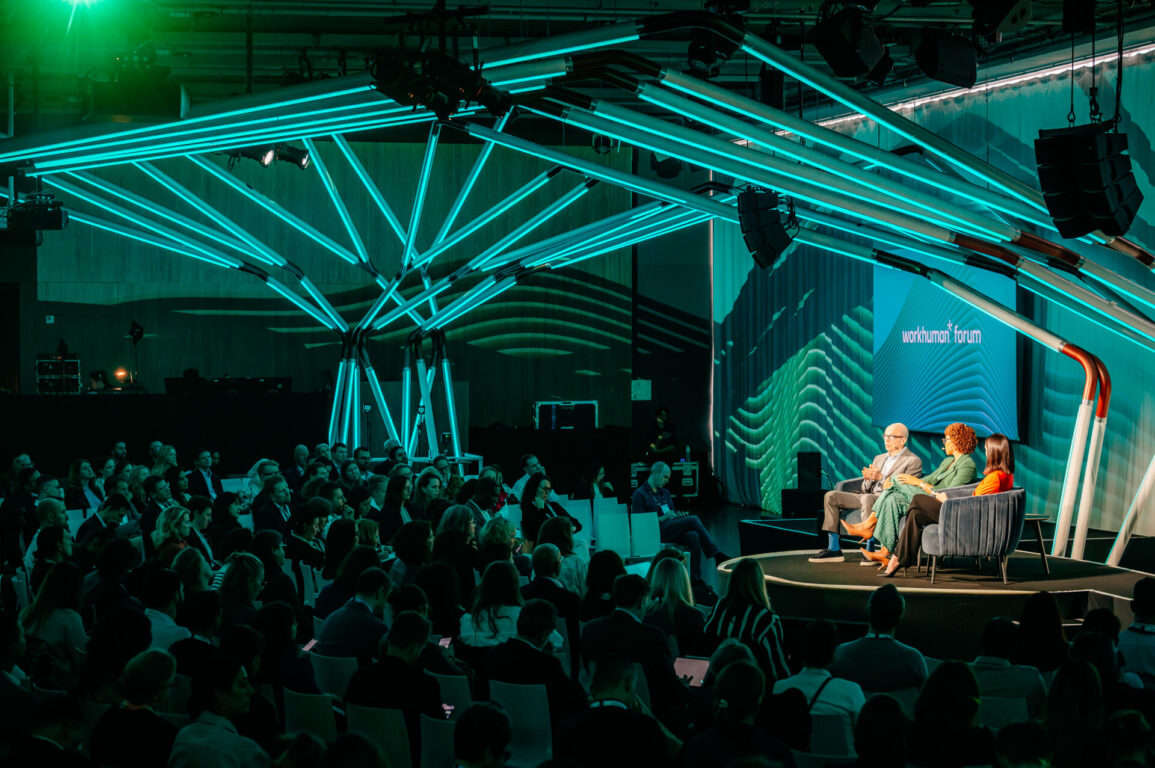
Alan Murray, KeyAnna Schmiedl & Holly Ransom on stage at Workhuman Forum in Paris.
CEOs are excited about AI – how can they maximize their ROI?
Studies from the likes of MIT, Deloitte and Stanford show that many companies are struggling to get real return on their AI investments.
The MIT research, for example, shows that only 5% of AI have an impact on company’s P&L.
Murray’s perspective is that “in a disruptive environment of new technology, that’s not bad”. “Progress happens at the margins” – organizations need to be patient and “give it time”.
Don’t shut everything down because you don’t get ROI in the first or second year.”
Murray spends a lot of time talking to CEOs – “what’s so interesting about this wave of technology is that is has generated the most excitement at the CEO level – that’s not normal”.
Compared to social media or crypto, “there was something about generative AI – it was so easy to learn, so easy to play with, and that quickly excited CEOs. They saw the potential to radically change their business”.
It’s good to have leadership from the top – but now CEOs tell him that they are frustrated. They’ve rolled out the technology to their people, and said “figure out how to make the most of this”, but they aren’t reaping the rewards.
There needs to be a better balance between a bottoms up and top down approach. While it’s good to have people experimenting with AI, “they’re never going to bubble up from the bottom”, there needs to be someone at the top deciding which projects to scale.
This approach is one that consultancies like KPMG are starting to take.
For Murray, organizations need to realize there’s a “different between playing with [AI], and being serious about it”. CEOs “can’t just say this is important, and think it’s going to happen”.
Success with AI requires “consistent focus, prioritization and follow through”.
In executing an AI transformation, Schmiedl is clear that the “CTO-People leader partnership is now more critical than ever”.
She is nervous about combining these roles into one (as companies like Moderna have done), but she believes that the “building the [AI] roadmap has to happen between those two roles, at the very least”.
By HR and IT working hand in hand, “what you really get is a focus on the human and the technology”. It also ensures that AI is not simply about solving a “HR centric challenge”, but truly transforming the business as a whole.
What Workhuman sees standout customers doing differently is “not just partnering with us within their HR functions, but introducing us to other leaders within the business”.
By taking this approach, “it’s not just about how the People function is thinking about these tools and having these conversations” – it is about the entire business’ strategic approach.