



The Adecco Group’s Daniela Seabrook says HR shouldn’t own workforce planning alone. Here’s why.
October 8, 2026

For HR leaders, 2025 has been “a truly significant inflection point as the forces of a tough economy, the future of work and HR innovation all converge in one dramatic moment in time”.
Those are the words of Fosway Group’s Chief Insights Officer David Perring as he reflects on this year’s iteration of the HR industry analyst’s HR Realities research.
This is the 11th year that Fosway Group has run HR Realities.
Let’s dig into the full findings – here’s everything HR leaders need to know from the data.
In the context of economic headwinds and the disruptive AI innovations, Fosway Group’s HR Realities research found that for the first time in four years availability of skills is not the top challenge for HR leaders.
It has dropped to sixth biggest challenge with 48% of the vote, with increasing organizational performance and productivity (66%) taking the top spot.
AI and the future of work (55%) is second, followed by managing economic and market pressures (53%) and managing the impact of automation and AI (50%).
All of this makes sense as 89% of HR leaders surveyed by Fosway Group said they felt their HR budgets were being squeezed – the research found that there are no positive trends in HR budgets and investments in the year ahead.
Over half (51%) expect their headcount to decline this year – and this is set to be a longer term trend.
HR is entering its “most cost-conscious era”, and vendors need to do better in articulating the “tangible gains” and “irrefutable advantages” of their technology if they want continued investment.
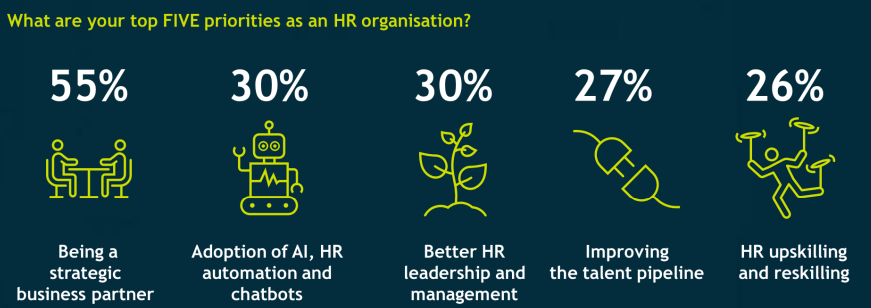
Fosway Group found the top priorities for HR are being a strategic business partner (55%) and adopting AI (30%).
Plus, the research found that HR sees high-quality data and analytics (64%), AI and AI agents (54%) and closer integration between HR and business systems (54%) as being crucial for the future success of the HR function.
It’s time for HR to “measure its value through business outcomes”, not just the employee value proposition, according to the report.
Plus, Fosway Group CEO David Wilson noted that HR needs to lean into the mantra of ‘human in the loop’, particularly in the context of AI-powered work.
Currently, 51% of HR leaders do not seen AI as overhyped, and 95% are already seeing some impact from AI in the HR function.
The main drivers of AI use is speeding up processes (63%), improving employee experience (61%), intelligent decision-making (52%) and reduction costs (50%).
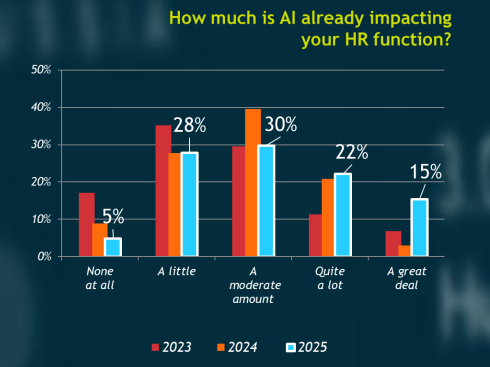
Having said that, Fosway Group’s data found that for seven in ten HR teams, AI is still scarcely more than an experiment.
Clearly AI is in the early adoption phase in HR – it is not yet a transformational feature – 86% of HR leaders report at least some challenge with AI implementation.
HR needs to be quicker at figuring out how AI changes both its purpose and its processes.