


Ask the Analyst: Job boundaries are blurring without anyone approving it – what's HR's first move?
October 5, 2026

Global think tank World Economic Forum (WEF) has published the inaugural edition of its Chief People Officers Outlook Report.
Based on a survey and consultation with more than 130 global CPOs, the report shows how the HR and people function is “shaping organizational resilience and business transformation and growth".
The report found that over the coming 12 months, people leaders will be primarily focused on priorities reflecting the dual challenge of managing immediate disruption while laying the foundation for long-term transformation.
UNLEASH dug into the report to uncover the four key takeaways for HR leaders.
Uncertain labor market conditions, typified by low job vacancies and employees seeking to hold on to current roles for longer (also known as ‘job hugging’), mean caution is the default approach among people leaders in the short-term.
WEF found that many organizations are holding off on hiring or restructuring decisions as a result, citing factors including macroeconomic volatility, geopolitical tensions and rapid technological transformation.
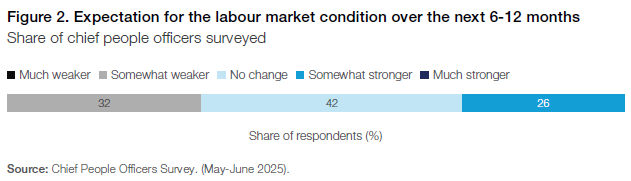
The report found “no clear consensus” among CPOs and labelled the overall outlook as “static”, with 42% of those surveyed expecting no change in labor market conditions over the next six to 12 months.
WEF noted that in the face of short-term stasis, CPOs emphasized the need to invest in longer-term change to traverse ongoing disruption in order to ensure organizational resilience and success.
As such, the HR and people function is seen as “playing a central role in designing and driving this transformation” among many organizations, the report stated.
While talent acquisition is being heavily impacted by macroeconomic and geopolitical factors on a global basis, with varying regional talent availability, making sure employees want to stay for reasons beyond a lack of options will be a significant priority for HR leaders.
WEF’s report found that CPOs recognize there is a shift in expectations among employees that is having a defining impact on how talent strategies are formed and implemented.
Workers have realigned their priorities and expectations, with a focus on flexibility and purpose, particularly among younger workers. One CPO quoted in the report described today’s talent as “confident, well informed and unapologetically selective".
An increased focus on mental health and increasing workplace polarization is being exacerbated by technology, it also found, changing “how people work, communicate and connect with organizations".
It is of little surprise to find that AI is top of mind for people leaders and WEF’s research underlines that there are both opportunities to take advantage of and risks to avoid for CPOs in the short-term.
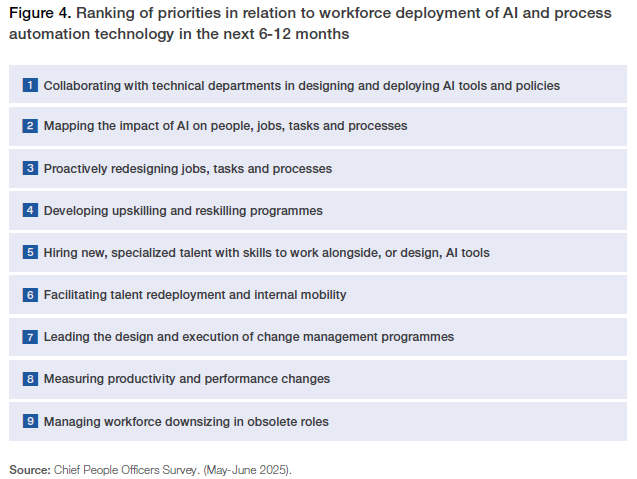
In terms of opportunities, WEF found that CPOs are prioritizing collaboration with technical departments, as HR departments work closer with IT teams or merge into a single entity in the era of AI.
Meanwhile, an equal prioritization on mapping out AI’s impact on people, jobs tasks and processes, and proactively redesigning theses facts demonstrates a “shared commitment to understanding how AI is reshaping work at different levels", the report noted.
WEF also highlighted a longer-term trend of CPOs broadening AI and talent strategies over the next five years, through hiring AI-specialized talent, workforce reskilling and restructuring roles.
Respondents cited the automation of repetitive tasks and admin, career development and upskilling, and embedding AI into daily workflows as their top opportunities in relation to workforce AI deployment in the next six to 12 months.
Conversely, employees not adapting or learning quickly enough, career stagnation, and ethical or data privacy issues where highlighted as the top three risks that AI deployment represents.
“Many chief people officers consulted for this briefing emphasized the importance of aligning workforce AI deployment with a long-term vision – grounded in clear business goals and workforce strategies – while maintaining a human-centered approach,” the report said.
As the workforces evolve and external influences shift, so too must the focus and capabilities of people leaders and the departments they lead.
WEF’s research shows that people leaders are increasingly prioritizing on aligning with overarching business strategies and objectives, with 100% of respondents ranking business acumen and strategic thinking in their top three success factors, with nearly 90% ranking it as their top priority.
Other top priorities for people leaders were stakeholder influence, and digital fluency and data literacy.
WEF noted that many CPOs canvassed in the survey acknowledged a gap in the digital skills across their people functions.