



The Adecco Group’s Daniela Seabrook says HR shouldn’t own workforce planning alone. Here’s why.
October 8, 2026

The COVID-19 crisis has affected all global industries. A year into the pandemic, businesses are now starting to figure out how to rebound from the disruption wrought by the coronavirus.
Digital transformation is at the front of CEOs' minds as they look towards the future, according to Ernst & Young (EY)’s think tank EYQ’s 2021 CEO Imperative Study.
A survey of 305 CEOs from Forbes Global 200 companies found that 61% plan to undertake a major transformation in the next year, while 68% plan to make major investments in data and technology in the same period.
As a result of the pandemic, EYQ concludes that digital transformation of the company’s business and operating models has been upgraded from important to urgent.
This is because “technology has been the common denominator for most organization’s resilience amid the pandemic,” according to EY global managing partner of Client Service Andy Baldwin.
“As vaccine rollout programs start to bring hope that we may be turning the tide, we are now seeing businesses shift their focus to assess how they can “win-in-turn” and this is driving investment plans over the next 12 months.”
EYQ’s report divides companies into ‘thrivers’ and ‘survivors’; the former reported revenue growth in the 2020 financial year, while the latter reported revenue decline last year.
It seems the pandemic accentuated the existing trajectories of companies — in other words, those who were already growing, continued to do so, while those who were lagging behind and struggling, suffered more from the pandemic.
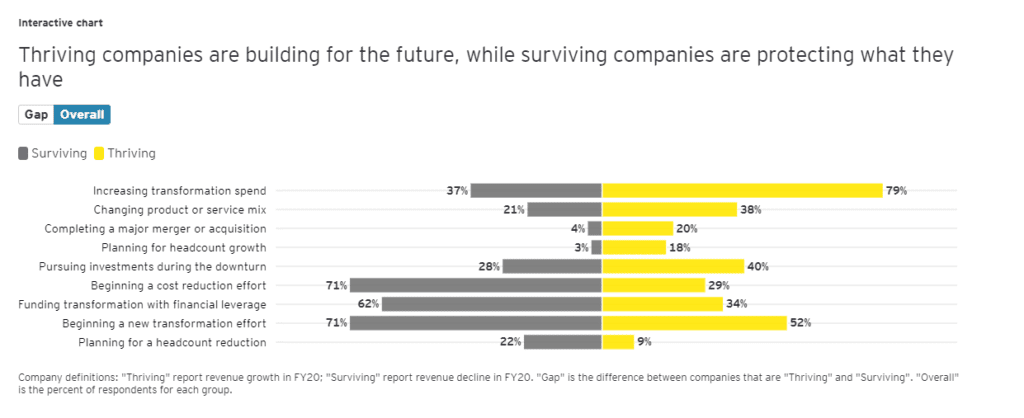
Therefore, the pandemic created an even greater divergence between the so-called thrivers and survivors with only 7% of survivors projecting growth in the next three years, compared to 79% of thrivers.
This is because 58% of CEOs of thriving companies have leaned into the pandemic and accelerated their digital transformation focus. This meant the 20% of thrivers were able to complete a major merger or acquisition, and 18% were planning a recruitment drive.
In contrast, 42% of the survivors instead focused on cost reduction, therefore downgraded their existing technology priorities. This meant that only 3% were planning a headcount increase, while 22% were planning on redundancies and lay offs.
As businesses, and particularly the thrivers, look towards greater digital transformation spend, they are focused on ensuring they place humans at the center of everything they do.
EYQ’s survey found that 68% had at least one transformation priority related to the importance of people, the cultivation of future talent and organizational culture. In addition, 15% had two people-focused transformation priorities.
In terms of CEOs' enterprise focus over the next three years, 17% expect to make major changes to their organization’s culture and purpose.
71% want to develop a workplace culture that focuses on change and transformation, but only 33% were focused on improving diversity and inclusion.
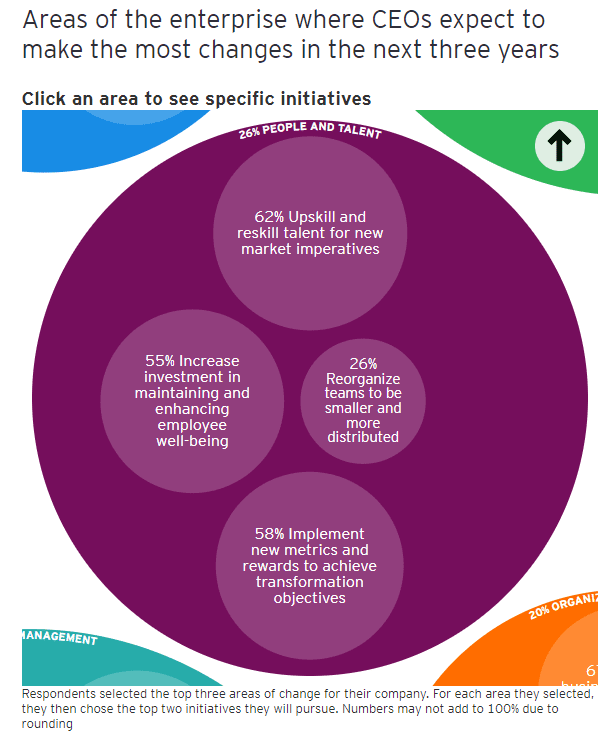
The survey also found that 26% of CEOs expect to make major changes to people and talent in the same period. Of which, 62% said they wanted to focus on upskilling and reskilling their existing talent, 55% said they wanted to focus on increasing investment to maintain and improve employee wellbeing, and 26% seek to reorganize their teams to be smaller and more distributed in this new world of hybrid working.
EYQ believes that human-centered transformation is central to enabling organizations to thrive in the post-pandemic world of work. It is then complemented by adopting technology at speed and driving innovation at scale.
To achieve this, EYQ recommends CEOs take steps including: