


The Talent Operations Transformation
October 6, 2026

Employee engagement is at its highest rate in five years.
Research and advisory firm McLean & Company studied more than 250,000 employees across 240 organizations and found that 64.2% were engaged in 2025 – up 1.6 percentage points from 62.6% in 2024.
This is good news for businesses. When organizations invest in their employees’ experience and engagement at work, they see 4x higher profitability.
This high employee engagement occurs in the context global economic uncertainty reaching its peak in April 2025.
As a result of these challenging economic conditions, McLean found that “intent to stay rose to 79.7% in 2025, up from 77.5% in 2024, the highest point in the last three years,” as Laura Hansen-Kohls, VP, HR Diagnostics, Advisory and Data Insights, McLean, tells UNLEASH.
Engagement and retention may be up, but Kohls warns: “This is not the moment to scale back engagement efforts.”
Given economic volatility is going nowhere in 2026 and beyond, HR must lean in to further improve on 2025’s engagement success.
It’s time for HR to be “practical rather than reactive,” notes Kohls.
Where should HR leaders focus their attention to drive engagement in 2026? From McLean’s data, here are three actions for HR leaders focused on keeping their employees engaged and reaping the productivity rewards.
The biggest drivers of engagement in 2025, according to McLean’s data, are coworker relationships, inclusion and culture.
This is where HR leaders need to double down in 2026.
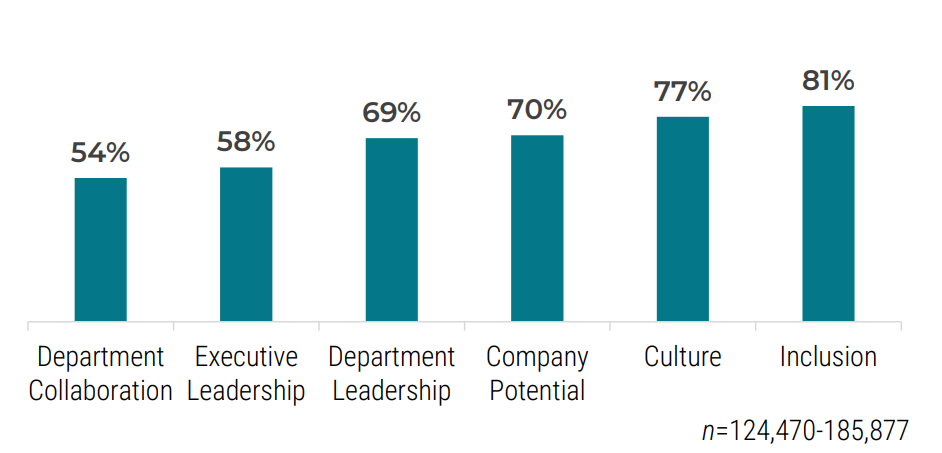
One element of culture that McLean’s research calls for HR to focus on is building on a culture of innovation within an organization.
Innovation is a top priority for organizations, especially as they are looking for ROI from their AI investments.
While the C-Suite needs to set the organization’s strategic direction with AI, often the best, most innovative ideas about how AI tools can transform work come from employees experimenting.
63.5% of employees told McLean their employer encourages innovation – this means that a third of organizations do not have the culture in place to enable AI experimentation.
Hansen-Kohls adds: “Without a culture that encourages experimentation and open dialogue, even the most advanced tools can fall short.
“Employees need to feel safe sharing ideas, testing use cases, and surfacing limitations – and trust that those contributions will be taken seriously.”
This echoes what Amy Edmondson said on stage at UNLEASH America 2026. She stated that HR’s role is to spread to the word across the organization that “the only way to make progress is through trail and failure.”
Not taking risks and staying in safe territory will not work in the future of work.
“I cannot promise if you take the time to learn from failures they will all turn into blockbusters, but I can promise you that if you don’t, they won’t,” concluded Edmondson.
The huge impact that managers have employee engagement and satisfaction at work is well documented.
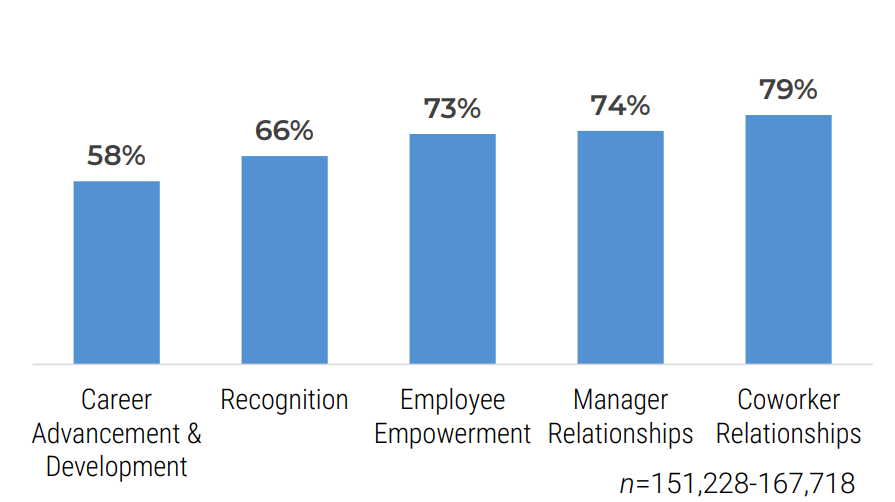
Gallup found that managers account for up to 70% of variance in team engagement, while McLean’s engagement study noted that manager relationships was the second top engagement driver related to someone’s role (74%), behind coworker relationships (79%).
Related to managers, McLean’s data also found that in 2025, leaders were better at providing feedback than ever before – and this is helping drive higher employee performance.
In 2024, 72.5% of employees said their manager provided meaningful feedback, which grew to 73.1% in 2025.
This is good progress, but McLean noted that there is more for managers to do to support employees with their career advancement and development. This was the bottom job-related driver of engagement in McLean’s study (58%).
McLean suggests that in order for managers to help their teams translate feedback into meaningful development opportunities, they need to embrace coaching.
Unlike feedback, coaching is future-looking; it is about building behaviors and mindsets that will put employees in good stead as work evolves.
But managers cannot do it alone; Gallup’s data found that while managers are key to employee engagement, they themselves are more and more disengaged.
HR needs to step up to support managers in the transition to coaching – this involves investment in upskilling and reskilling, including providing toolkits, microlearning, and internal mentoring.
McLean’s report stated: “In 2026, strengthening leaders’ coaching capabilities is critical to drive employee development, especially as skill demands continue to shift with the changing nature of work.”
McLean found that compensation is the lowest retention driver (52%) – compared to work-life balance (65%) and work environment (76%).
There’s also room for improvement with benefits – with 40% of employees telling McLean they were not satisfied with their benefits package.
HR must keep a close eye on these engagement figures – yes, retention is flat now, but that cannot be taken for granted in the long-run.
The situation is complicated by the EU Pay Transparency Directive; this comes into effect in June 2026, so this new regulation needs to be prioritized in any HR strategy.
As McLean’s report stated, when it comes to benefits and compensation, it is not always about spending more, it is about prioritizing.
“An effective employee listening strategy becomes critical to ensure limited resources are focused on what matters most,” noted the report.
The key to effective employee listening is to ensure you actually take action on the data; as Hansen-Kohls concludes: “In 2026, organizations that move beyond measurement and act on what employees are experiencing day-to-day will be in a much stronger position."