



Ask the Analyst: Job boundaries are blurring without anyone approving it – what's HR's first move?
October 5, 2026

Employee attitudes about work have been completely transformed over the past few years since COVID-19 – but experience management giant Qualtrics predicts that workers’ expectations will reach new heights in 2024.
Based on a survey of 37,000 employees across 32 countries, Qualtrics found that in comparison to 2023, where customers were top of mind, the employee engagement theme of 2024 will be balance.
Employees want better tech, but they want to use it for good, they want flexible and hybrid work, they expect to be heard and for leaders to take action based on their feedback.
In this context, the job of CHROs, and their broader HR teams, is far from done – if anything, they will become even more important and act as a glue between organizations and their biggest asset, their people.
The big question is where should HR leaders start? What should they prioritize? Let’s dig into Qualtrics’ employee experience (EX) top trends for 2024.
Speaking exclusively to UNLEASH, Sarah Marrs, director of EX strategy execution at Qualtrics, shares: “One of the things that immediately stood out to us from the research was the change in tenure and sentiment.
“Generally, you expect to see a 'C' curve in tenure patterns - employees start out more positive, start to dip after the first year, then go back to being positive around the seven-eight year mark.
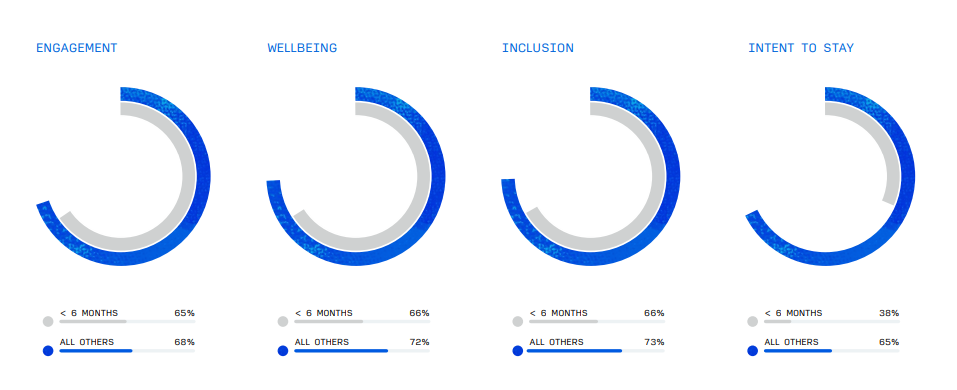
It is clear the novelty of a new job is not enough to keep engagement up for the first six months, which is a huge issue for organizations as they may be spending up to $5,000 per new hire.
Qualtrics data shows that the solution comes from rebuilding and rethinking onboarding strategies – while 50% of CHROs said hiring was a top priority, only 41% said the same for onboarding.
Marrs adds: “That’s a 10% gap of new hires who are not walking into a deliberate onboarding program.
Ultimately, “the old maxim of ‘give it a year’ is no longer the thought process. HR should start seeing the onboarding process as an extension of the hiring process - just because employees have signed doesn't mean they’re necessarily committed”, she continues.
For Qualtrics, this need to rethink onboarding links with the second theme: hybrid work.
The research shows that hybrid workers are the most engagement.
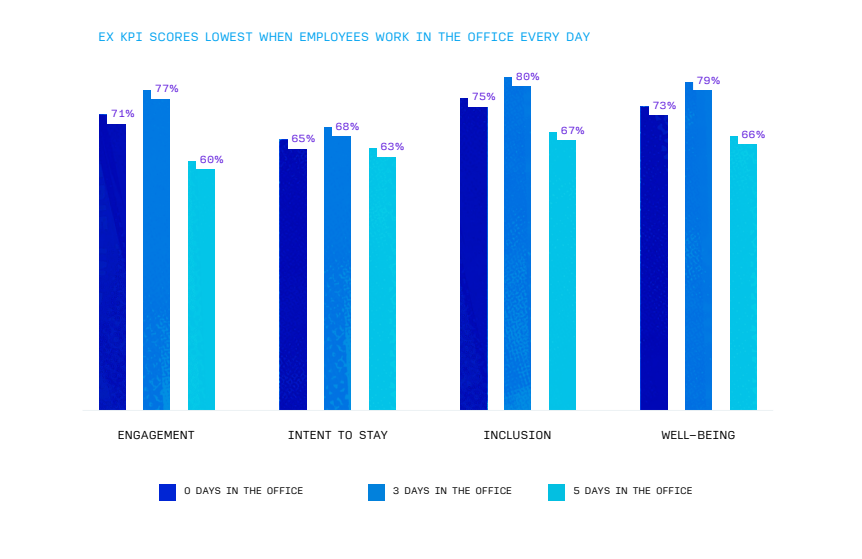
But it is important that remote workers are not overlooked during the onboarding process.
Marrs adds: “While employees will still be trained on how to do the job, it’s possible that the other crucial aspect of onboarding - building relationships and feeling part of the company - is not being attended to.
“In a hybrid work environment, this needs to be deliberately cultivated. Managers must be guided and enabled to create those consistent connection moments for new joiners e.g. aligned days in the office or team outings when a new joiner starts.”
Going back to hybrid and its impact on engagement, Benjamin Granger, Qualtrics’ chief workplace psychologist, warned: “A one-size-fits-all approach may not be the best strategy, and leaders would be wise to build in flexibility within their work location policies and bring people together with purpose.”
Ultimately, employers need to really listen to their employees needs and preferences around hybrid work, but also other topics like career development (a major driver of employee engagement) and AI.
Currently, 86% of top leaders think that organizations respond to feedback, but only 48% of individual contributors agree – that’s a 40 percentage point difference.
To help, employees are open to new technologies, and particularly passive listening of their emails and other work messages (70%) and AI (42%).
Granger comments: “Trust and transparency are paramount when it comes to incorporating passive listening.
“Leaders can gain valuable insights into what is positively or negatively affecting employees’ experiences through passive listening, but they must be open with employees about how this information is being used – and how it is not.”
Trust and transparency are also essential for the successful implementation AI, and for organizations to reap all the AI rewards.
Currently, while 65% of the C-Suite are on board with AI, only 46% of managers and 32% of individual contributors agree.
“This highlights a tangible benefit of employee engagement and the importance of communicating the individual benefits of AI as leaders look for ways to use intelligent technologies to increase efficiency and business results.”