Companies waste $1.7 trillion every year on unproductive ‘shadow work’, finds Perk
Shadow work includes tasks like filing expenses, booking travel and chasing approval; it is time consuming, and distracting for employees, and has a knock on effect on organizational productivity. That’s according to new research from Perk (formerly TravelPerk) – UNLEASH digs in with Perk’s VP of People.
News In Brief
Perk (formerly TravelPerk) has found that 'shadow work' is destroying productivity, and that is very costly for organizations.
What's the solution? What role does HR need to play?
UNLEASH dug into the to data with Perk's VP of People Felicia Williams.
‘Shadow work’ – the hidden manual tasks that are outside the remit of people’s jobs, like filing expenses, chasing approvals, booking travel and reconciling invoices – is costing companies $1.7 trillion every year.
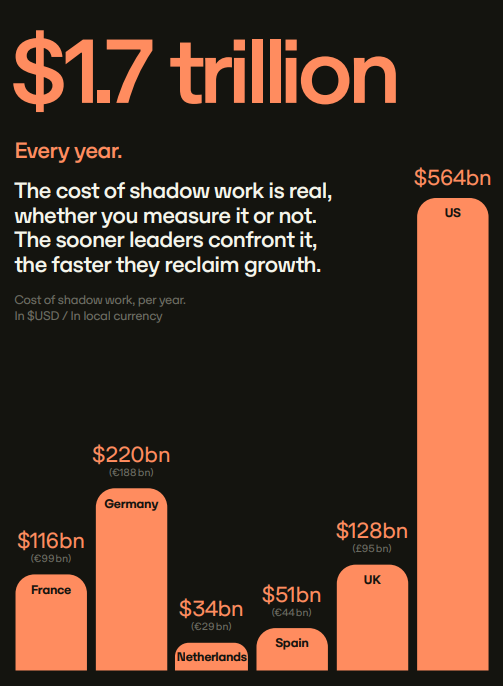
That’s according to new global research from Perk (formerly TravelPerk) and Forrester Consulting.
Perk and Forrester surveyed 8,000 employees and 700 leaders, and found that every employee is wasting an average of seven hours a week on shadow work.
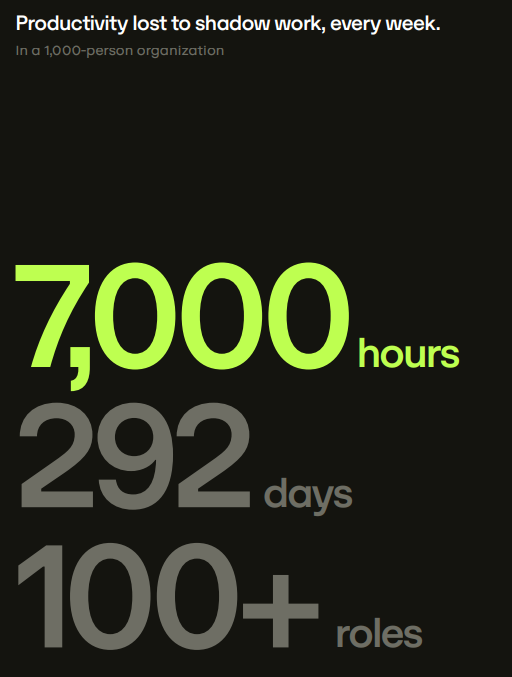
Not the mention that each shadow work task adds 11 minutes of distraction as employees re-focus on their real work.
This “goes beyond being a productivity challenge, it’s a systemic failure in how we’re enabling our people to do their best work”, Felicia Williams, VP of People at Perk, tells UNLEASH.
She continues: “What stood out most to me was the human toll.
“Nearly half of employees say shadow work is a leading cause of burnout, and over half say it’s increasing year-on-year. That should set alarm bells ringing for every HR leader.
We talk about employee engagement, satisfaction and retention whilst these time-draining tasks are going unnoticed and taking our teams away from their real work.”
The research shows that 50% of employees say shadow work reduces their employee satisfaction, while 58% say it distracted them from meaningful work and 80% described shadow work as disruptive or catastrophic.
Yes, “shadow work is costing us more than we realize. But the good news is, we can change it. The tools exist. The choice is ours,” added Perk’s CEO & Co-Founder, Avi Meir.
How HR can combat shadow work
Clearly, shadow work is impacting bottom lines – it’s “eating away at margins and morale”, stated the report.
How can organizations reduce shadow work and reap the rewards?
First of all, organizations need to look at their tech tools. 67% of leaders are committed to automation, but employees are grappling with too many tech tools.
Only 7% of employees surveyed said they had an integrated tech stack – most are using four different tools for shadow work.
“If we want our people focused, fulfilled and future-ready, we need to simplify the systems around them,” comments Williams.
The data found that better tools are a key motivator for people to stay in their current roles; 38% noted that access to AI tools to reduce manual or repetitive tasks and 37% stated that automated systems to improve productivity were top retention drivers.
It’s not just IT’s job to improve tech stacks, there is also a role for HR, Finance and Operations teams. In fact, Williams calls for these departments to all work together to get rid of shadow work and “build environments where people can thrive, not just cope”, adds Williams.
With less shadow work, according to Perk’s data, employees would spend their time focusing on their job, learning new skills, and improving work processes – all of which are productive and business critical tasks.