

The Talent Operations Transformation
October 6, 2026
For every 100 men promoted in the workplace in 2024, only 81 women were promoted, according to McKinsey’s Women in the Workplace report.
In fact, promotion rates of Black women regressed to 2020 levels, and Latinas were shown to face the greatest impacts.
As a result, women remain underrepresented at every stage of the corporate pipeline, so much so that McKinsey predicted that it'll take 50 years for women to achieve parity in the workplace.
At UNLEASH World 2024, three pioneering leaders spoke on the topic of DEI to share what they believe are the most pressing topics for achieving equality in the workplace.
“Only 20% of women are in positions of power,” said Kelly Algier, Head of Coaching Science at Speexx, as she opened her session at UNLEASH World 2024.
To answer this, Algier suggests that we have to look at both ourselves and society.
“There's no blame,” she says, "there's just curiosity. How did we get here?”
One factor Algier highlights is leadership bias, which she says is the “inclination towards a particular perspective, idea, or group, which influences judgment.”
For example, people tend to favor world leaders that are overconfident, assertive, aggressive, abrasive, bold, charismatic, and sometimes, narcissistic.
“That's how we define leadership,” she adds, “those are traits that we as a society appreciate.”
However, there is a fundamental difference between confidence and competence, with Algier stating that confidence is how good you think you are, and competence being how good you really are.
Yet women bring different leadership qualities to the table – self awareness, humility, empathy, for example – which can benefit businesses on many different levels.
“I'm not talking about adding one more woman to your board,” Algier adds. “I'm saying we need to have women at a critical scale. That's at least 30% of the boards, at the C-level and in higher positions of government.
“If there’s more women, the science shows that we improve financial performance, reduce risks, and improve corporate and environmental social responsibility. This is because we create humanity, but we have a slightly different mindset, so addressing our leadership bias is going to take a long time.”
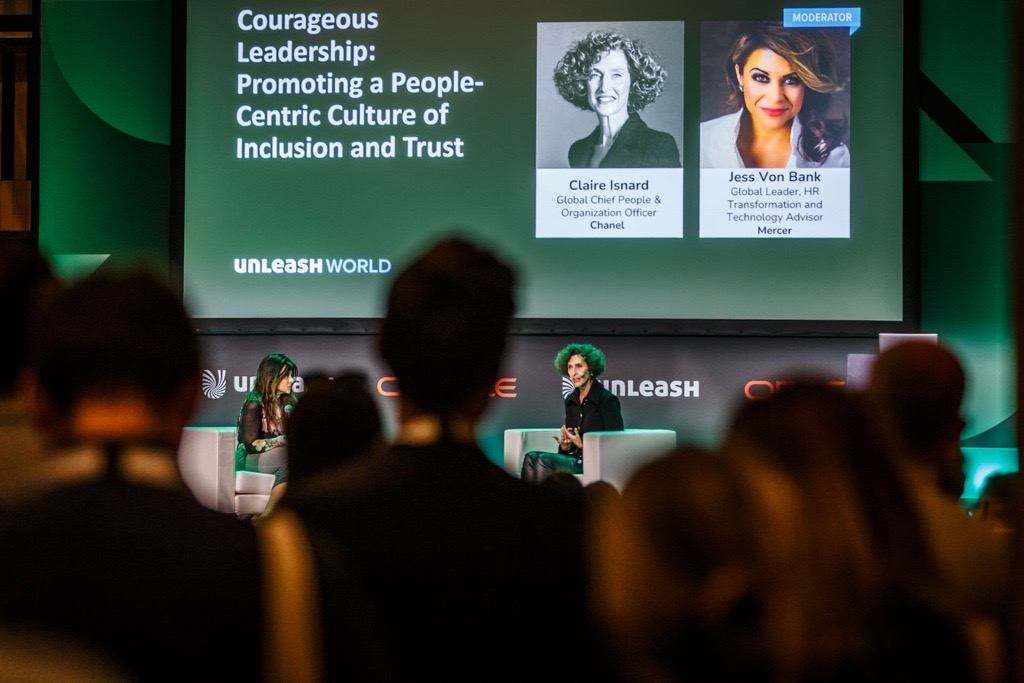
Building upon this thought, Chanel’s Global Chief People & Organization Officer, Claire Isnard, reiterated the importance of leadership.
She explains: “When it comes to bringing courageous leadership to life, there’s a few things that are very important.
“The first is to always be grounded into purpose and vision. What do you want to bring to the conversation? What do you want to bring to the company, so your leadership can focus on what matters and what is relevant to all the people who have a role to place.”
To achieve this, Isnard highlights that leaders need full transparency, with the “empowerment of people” being imperative for employees to work to their full potential, while allowing them to contribute on a greater level.
Echoing Isnard's and Algier's thoughts, Jolie den Boer, Global Director of Talent Acquisition of Booking.com expresses the importance of having female role models in senior leadership positions.
She says: "Practice what you preach. If you have female leaders at the top, then more females will come to your company. This needs to be a focus, especially for tech businesses, because the market is still proven to be male dominated."
“If there’s more women, the science shows that we improve financial performance, reduce risks, and improve corporate and environmental social responsibility. This is because we create humanity, but we also have a slightly different mindset, so addressing our leadership bias is going to take a long time.”
Although gender is an important aspect to DEI, den Boer expresses that it shouldn’t be the only focus.
"I don't think that DEI is just between men and women, I think we need to be much more representative of different communities as well, for example, people with handicaps.
"So it's important that it's on the agenda, and that it stays on the agenda."
In fact, when asked to share the top takeaways for other HR leaders, she reiterates that HR leaders need to “look beyond gender.”
“There’s more to DEI than just males and females, so, what else can you do as a company?,” she asks.
With this in mind, is your business doing all it can do to create equitable workplaces that enable leaders to thrive?