



'Digital Me' is turning human capability into corporate assets. HR must push back
April 27, 2026

Most current leadership advice treats uncertainty as a single condition, but the trust is uncertainty varies dramatically.
Because uncertainty comes in different forms, no single leadership style works across all situations. Therefore, leaders need a practical way to adjust their behavior as conditions shift.
Uncertainty varies, depending on source, duration, and consequences.
It can have social, cultural, economic, technological, political, geopolitical, and weather-related roots.
Uncertainty in global trade is caused by a combination of geopolitical, economic, and climate-related factors affecting supply chains, energy costs, and crop yields.
Uncertainty can be episodic, or enduring. We perhaps thought that uncertainty from the 2026 Iran war would be short-lived; it now looks as if this could last for months or years.
Uncertainty’s consequences are uneven, affecting individuals, groups, organizations, and economies. The implications range from discomfort (expensive petrol) to existential (no petrol).
No single leadership style can deal with this range of contingencies.
Borrowing from photo editing, leaders can adjust their behavior along five continuums - moving toward one end or the other depending on what the situation demands.
Extremes are sometimes necessary, but most of the time leaders must strike the right balance.
Applying this concept to leadership style, there are many dimensions to choose from.
Here are five sliders for illustration:
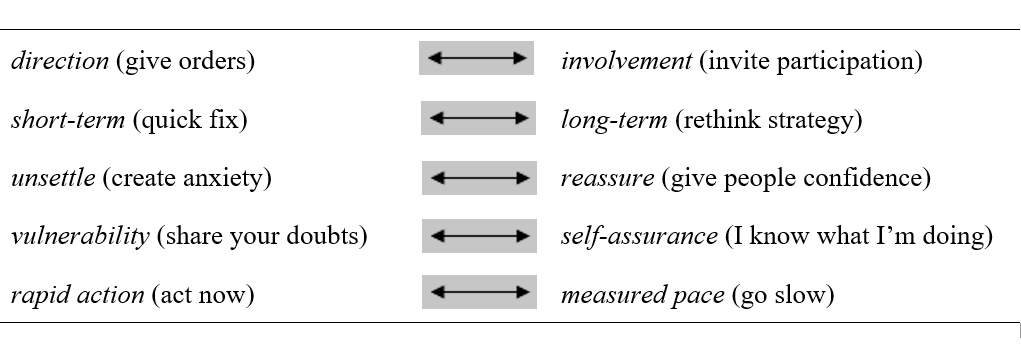
Direction vs involvement: Uncertainty implies a need for direction. However, it may sometimes be useful to encourage participation, to generate ideas, and to place your style in the middle of this continuum.
Short term vs long term: At one extreme, solve the immediate problem. At the other extreme, use a volatile situation to review long-term strategy. You might begin looking at the short-term issue, then move along the continuum to explore strategic possibilities.
Unsettle vs reassure: You may need to unsettle employees, to shake out complacency that things are okay. However, if staff have been traumatized by a crisis, you may need to use the reassurance end of the continuum.
Vulnerability vs self-assurance: There are occasions when sharing self-doubt heightens your image of integrity and authenticity. But this can be damaging if you appear indecisive when urgent action is necessary.
Rapid action vs measured pace: The situation may get worse if you do not act fast. But acting before the situation is clear may be a mistake. This is a tricky judgement call, especially where action is expected, and delay could be seen as indecisiveness.
The key questions for leaders facing uncertainty are:
There are costs in getting it wrong.
If you add too much direction, you could trigger apathy. Focus on today, trigger short-termism. Add reassurance – complacency. Add doubt – anxiety. Add speed – poor decisions.
Style editing is a judgement call based on the situation.
Situational responses face two criticisms.
First, can leaders change their style?
Second, problems might arise if a leader’s behaviour is inconsistent.
Flexibility
We all have behavioral flexibility, allowing us to function in different social settings.
If you behave at home as you behave in the boardroom, expect family tensions to arise. We exercise this flexibility unconsciously.
The skill is to do this deliberately, sometimes stepping outside our comfort zone.
Consistency
There are two modes of consistency. One concern is being consistent with previous behavior. The other concerns acting in a manner consistent with the nature of the current problem.
The latter is more important when faced with changing uncertainties.
In a crisis under pressure, we tend to resort to instinct or habit. If you are being expected to act in a way that is ‘not my thing’, work with another board member to handle that issue with you.
However, leaders do not operate in a vacuum, and have to accept constraints.
An organization’s culture may expect particular behaviors, key stakeholders may not welcome displays of vulnerability, and other board members may demand fast and decisive decisions.
How can HR build leadership capacity to address uncertainty?
Classroom methods are inadequate.
We need a blend of individual and group work:
Leaders don’t choose a style; they edit their behavior to fit the circumstances.
Leaders who navigate uncertainty best adapt appropriately, create urgency when required, reassure when called for, give direction when possible, and involve others when that is helpful.
HR leaders must confidently support and encourage this flexibility to achieve the required results.