


The ladder is missing rungs: Where will your next senior leaders come from?
October 6, 2026

Workers across the world are excited about AI, and see its potential to transform how work gets done.
However, “it’s not all smooth automation and productivity gains”, Sam Dawson, Senior Director of Workforce Transformation at employee experience giant Perceptyx, tells UNLEASH.
Perceptyx surveyed 3,600 employees in North America and Europe, and found that while 57% say they use generative AI often, 27% report no usage or interest in the tools. A further 16% said they weren’t using AI yet, but were interested.
For those who are using AI, 42% said they were more productive, but this comes with insecurity in their jobs (14%).
This discrepancy is particularly stark in North America – while 43% say they are more productive because of AI, 16% feel less secure in their jobs as result (compared to 40% and 10% in Europe respectively).
“For organizations with a global footprint, these regional differences are more than academic” – they say a lot about about employee readiness in various geographies, and also inform how organizations need to respond to drive AI adoption.
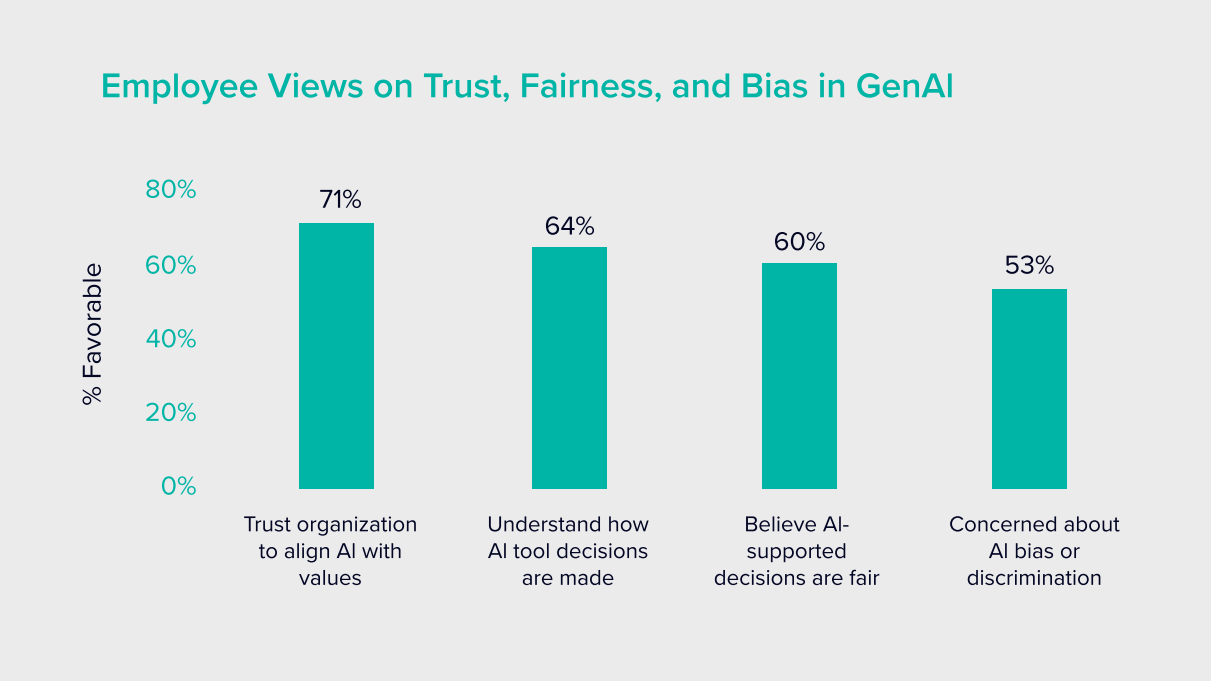
Perceptyx’s data shows that there’s a lack of trust and transparency, and concerns about ethics.
53% of respondents said they worried about discrimination in AI decisions, and only 62% said their organization has communicated how AI will or won’t affect their jobs.
Currently, there is “lots of curiosity, [but] not yet consistency”, according to Dawson.
What actions do organizations need to take to move the needle and drive not just efficiency, but also employee confidence in the GenAI-powered future of work?
UNLEASH explores the answer with Dawson.
It is clear that giving employees access to AI tools isn’t enough to guarantee adoption or success with those tools, finds Perceptyx.
As Dawson puts it: “Tools don’t drive transformation. Trust, enablement, and equity do.
“If you treat it like a people transformation project, with managers at the center, employees in focus, and transparency as the operating system, you’ll be on the path to unlocking real, lasting change."
There’s a lot of work for HR and the C-Suite to do here.
Dawson shares that the first thing is to “be transparent. Employees don’t just want the 'what', they want the 'why'. Be open about how tools are chosen, what’s changing, and what’s staying the same”.
Secondly, it’s crucial to “back your managers”, he notes.
Perceptyx’s report talks about how managers are “at the center of the GenAI transformation”.
Managers are “the bridge between strategy and reality. Give them guidance, training, and time to help their teams adapt, not just more to-dos”, in Dawson’s words.
Currently, only 64% of workers said their manager actively helps their team adapt to generative AI. This figure drops to 57% in Europe, and rises to 66% in North America.
Ultimately, by switching the mindset from being about to tools to being about change management, “leaders can transform GenAI from a source of anxiety into a catalyst for innovation and engagement”, concludes the report. This in turn reaps business rewards.