


The ladder is missing rungs: Where will your next senior leaders come from?
October 6, 2026

Workers and executives alike are excited about AI – it has shifted from being a nice-to-have, to being a workplace staple.
That’s one finding of Atlassian’s 2025 AI Collaboration Report.
The tech giant surveyed 180 Fortune 100 executives, and 12,000 knowledge workers, and found that daily AI usage doubled over the past year.
Workers and executives believe that AI makes them 33% more productive, and the proportion that think that AI is useless has dropped by 78% in a year.
Executives believe that AI makes them a better leader, and 62% say improved efficiency is the top benefit.
While workers are reinvesting the time saved from AI in things like process improvement (43%), strategic planning (43%) and professional development (42%), Atlassian’s report found that organizations are struggling to transform personal productivity gains from AI into organization-wide transformation.
96% are not seeing dramatic improvements in organizational efficiency, innovation or work quality.
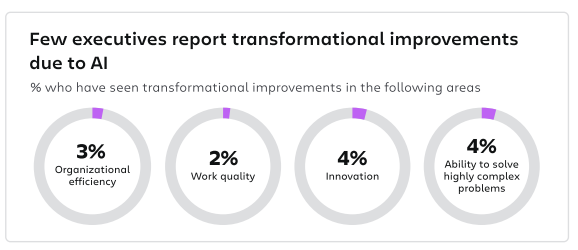
The issue is that 76% of leaders see driving productivity as the number one indicator of whether or not AI investment is paying off. This approach, however, means they are 16% less likely to drive innovation than the 4% who are seeing organization transformation.
Atlassian found that focusing on personal productivity, rather than innovation, with AI could cost the Fortune 500 $98 billion annually in lost returns on their AI investments.
This begs the question, what is that 4% doing differently? UNLEASH spoke to Dr Molly Sands, Atlassian’s Head of Teamwork Lab, and dug into the full data.
Speaking exclusively to UNLEASH, Dr Sands shares: “My key takeaway from this year’s AI Collaboration Index is that while a lot of companies are using AI to make individuals more productive, the real transformation happens when teams use AI to work better together.
“If we focus only on efficiency, work can actually become more scattered, with everyone moving quickly but not necessarily in the same direction.”
37% of leaders acknowledge that AI has wasted their teams’ time or led them in the wrong direction.
Atlassian’s report is clear that business success starts with AI-enabled coordination – companies that focus on this are nearly 2x as likely to say AI has driven organization-wide transformation.
So, how do organization move from individual productivity to company-wide impact?
They need to set up a connected company-wide knowledge base, they have the right systems and tools to enable true AI-powered coordination and they make AI part of the team.
Dr Sands continues: “The real value comes when AI helps teams share context, connect the dots, and solve problems together.”
She recommends that leaders are "clear about the outcomes you want to achieve, make it easy for people to capture and share knowledge as part of their daily work, make AI available to every team and experiment to see where it can make a difference".