


'Digital Me' is turning human capability into corporate assets. HR must push back
April 27, 2026

Companies that embrace AI are seeing 3x the productivity of those that haven’t.
That’s according to PwC’s 2026 AI Global Jobs Barometer, which measured one billion job ads from six continents to find out AI’s affects jobs, skills, wages and labor markets.
Being highly exposed to AI pushes productivity 40% higher on average – jumping to 163% for the top 20% of AI adopter companies. PwC calls this the ‘superstar effect’.
Importantly, those productivity gains for top employers are not being used to cut costs. Instead, they are boosting headcount and wages.
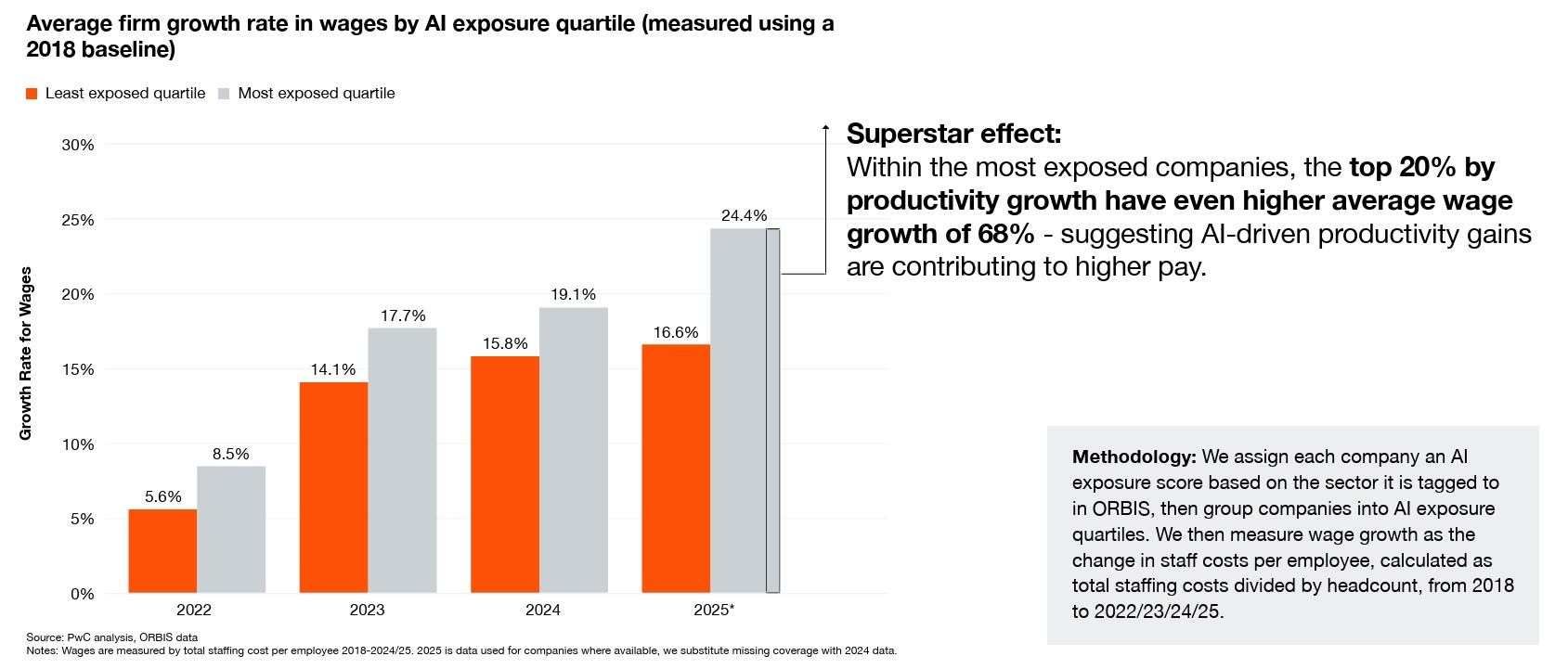
PwC’s report concluded: “Far from being a job killer, AI may actually be a job expander.”
Shebani Patel, Principal, Workforce Solutions Leader, PwC US, tells UNLEASH that this is “a clear sign that AI is amplifying human performance rather than replacing it.”
Here are three things HR leaders can learn from the AI superstars.
PwC’s report stated that in 2026 a two-track labor market has emerged between those roles that have democratized by AI, and those that have been professionalized.
Almost one quarter (22%) sit in the latter camp. AI has reshaped roles like R&D managers, air traffic controllers and musicians to require even more human expertise.
By comparison, democratized roles (56%) are those that AI has made easier for non-experts to perform, such as inventory and accounting clerks, interior designers, and IT service managers.
Because of AI’s disruption, “professionalized jobs are thriving; numbers of professionalised jobs are growing twice as fast as democratized ones, and with 42% higher wage growth,” stated the report.
This means that there’s “a bright future for workers in professionalized roles as AI makes them even more valuable”, according to PwC’s report.
For HR teams, this signals a need to index on professionalized roles by investing in reskilling and upskilling their workforce.
PwC’s report found that wage premiums for workers with AI skills have risen to 62%, up from 57% last year. However, there’s also a need to focus on human skills like empathy, creativity, judgement and leadership are to success with AI.
As PwC’s US Chief People & Inclusion Officer, Yolanda Seals-Coffield, shared with UNLEASH, “while we need to grow, develop and do things differently in the age of AI, we would be remiss if we lose sight of that it is truly our unique human qualities” that drive competitive advantage.
There’s been a lot of doomsday talk about AI’s impact on entry level work.
PwC’s report identified that the career ladder is “compressing,” with job postings growing more slowly for entry level work most exposed to AI.
However, job growth outcomes were tied to upskilling, and specifically if AI-exposed early career roles were being upskilled to more senior skills.
PwC’s report showed that AI-exposed entry level work is 7x more likely to demand those senior skills, which PwC defines as capabilities like people and stakeholder management, strategic and data-driven decision-making, and team building.
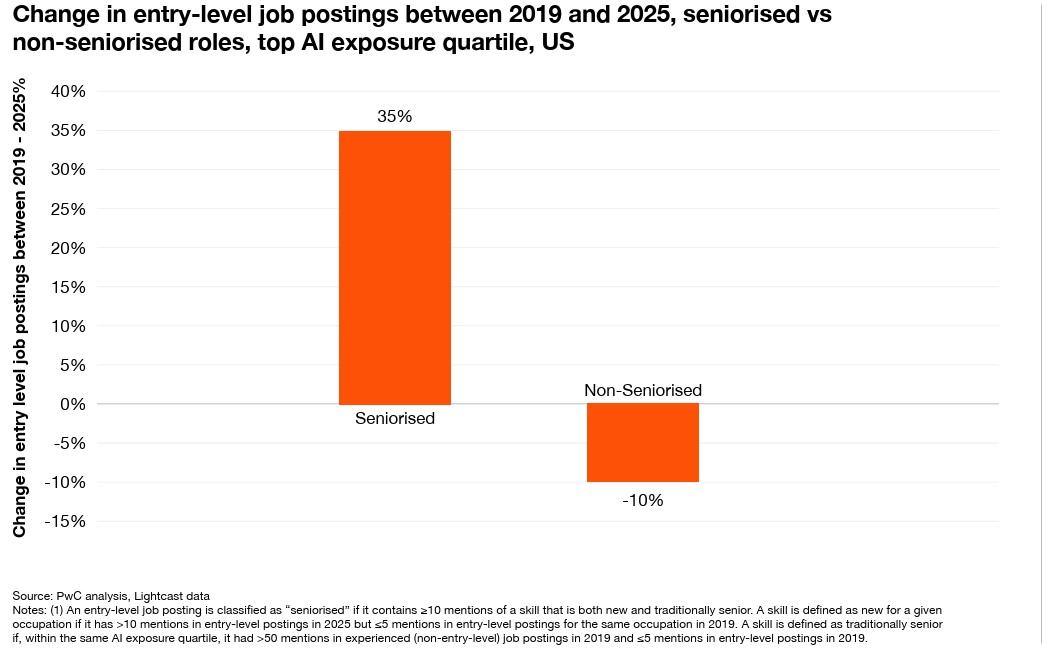
This shows that entry level work will not look the same as it did in the past. HR teams need to “rethink how they mentor and train junior staff, helping them step up to complex decision-making much earlier in their careers,” stated the report.
Ultimately, PwC’s Patel tells UNLEASH that HR must remember that those “that will be most successful implementing and leveraging AI won't be those that simply deploy the latest technology.”
The key is pairing the right tech with workforce readiness.
Rather than seeing workforce planning as something done once a year, Patel shares that “organizations need a more dynamic approach to understanding skills, identifying emerging capability gaps, and creating opportunities for employees to continuously learn and adapt.”
HR, IT and business leaders must, therefore, work together to help “people build the skills, experiences, and confidence needed to work alongside AI.”
This cross-functional collaboration will also enable organizations to prioritize growth, rather than efficiency, from AI, according to PwC’s report.
HR must consider how AI can help organizations “unlock new revenue, enter new markets, and create new forms of value”, rather than simply speed up existing processes and approaches.