


The ladder is missing rungs: Where will your next senior leaders come from?
October 6, 2026

The 2025 iteration of BCG’s AI at Work Report has found frontline workers have hit a “silicon ceiling” with generative AI use.
Surveying 10,635 employees across 11 nations, the report found 72% of leaders, managers and frontline workers are regular Gen AI users – driven by leaders and managers.
Frontline workers use has stalled at 51%, down 1% percentage point from the previous report in 2023.
“Companies are realizing that merely introducing AI tools into existing ways of working isn’t enough to unlock their full potential. Real value is generated when businesses reshape their workflows end-to-end and promote use of the technology,” the report stated.
UNLEASH took a deep dive into the report’s findings with Nick South, Managing Director and Senior Partner at BCG, to uncover four key takeaways for HR leaders.
While use of Gen AI among frontline workers has remained static in the past 24 months, after an explosion in use between 2018 (20%) and 2023 (52%), mangers instead took up the call.
Regular use – defined as people that use AI several times a week or daily – rose 14% among managers to 78% in 2025 (64% in 2023, 46% in 2018).
Despite a stall in use, confidence among frontline workers has grown to 36% in 2025, a significant increase from 2018 (17%), while concern has dropped from 40% to 28% in the same period.

“When leaders demonstrate strong support for AI, frontline employees are more likely to use it regularly, e.g., the share of employees who feel positive about Gen AI rises from 15% to 55% with strong leadership support,” South says.
“However, only one quarter of frontline employees are currently receiving that level of support, which has a marked impact on overall AI adoption levels.
Another potential explanation for a stall in frontline worker uptake of Gen AI is a lack of training.
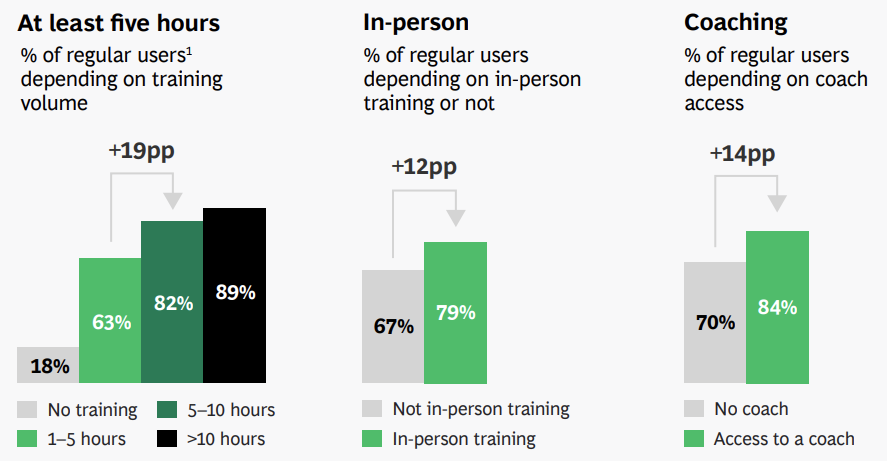
BCG found that only 36% of employees believe their training is “enough”, with 18% of regular AI users saying they had received no training at all.
The report states that a combination of “instruction, in-person sessions, and coaching are key components of effective training.”
Overall, 79% of respondents who received more than five hours of training were found to be regular AI users, compared with 67% of those who received less than five hours training.
Meanwhile, the use of unauthorized and ungoverned AI tools in the workplace - also known as Shadow AI - presents a significant security risk for organizations.
With 54% of employees stating that they would use AI tools that have not been authorized by the company, younger workers in the Millennial and Gen Z (62%) age groups were most likely to bypass restrictions.
“In our research, over half of employees admit to using unauthorized AI tools – a clear sign that demand is outpacing access,” South comments.
“To reduce risk and boost performance, companies must meet this enthusiasm with responsible and supportive tools coupled with practical training.”
Agentic AI is predicted to dramatically reshape the future of work, but at present, adoption is sporadic and employees are missing out on the full value of the technology.
BCG found that just 13% of organizations surveyed have deployed AI agents that are integrated into broader workflows, while more than half (56%) are using agentic AI experimentally, in pilots, or under human supervision.
The remainder (31%) have yet to implement AI agents in any form.
Despite the current levels of adoption, employees are able to recognize the potential agentic AI offers, with 77% of respondents stating that AI agents will be important in the next three to five years.
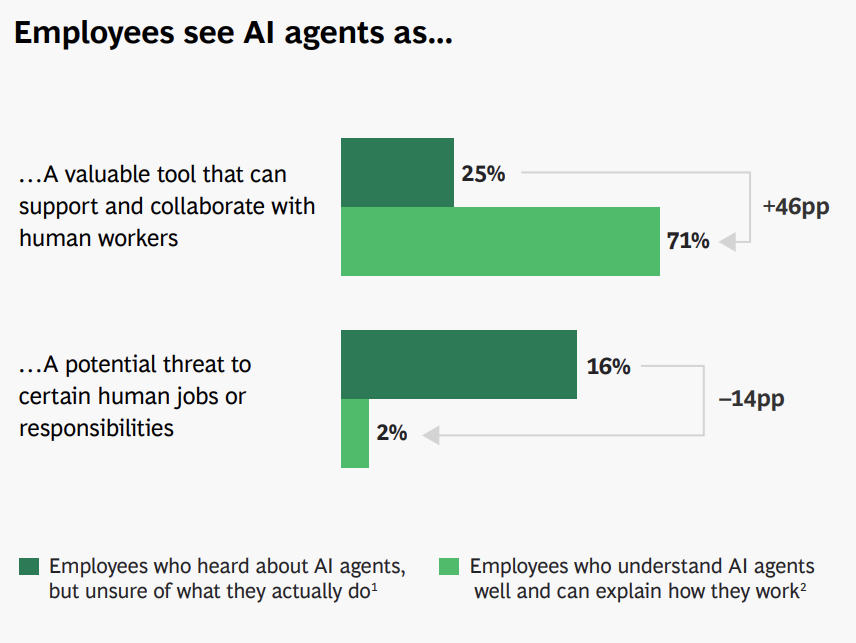
However, just one in three (33%) said they have a clear idea of what AI agents are.
While knowledge of what this technology can do and how it works allows employees to support their co-workers and move past fears of what the AI means for the future of human-based work, concerns persist over the impact of AI agents.
The top three concerns BCG found were decisions being taken without human oversight (46%), an unclear accountability when mistakes occur (35%) and the introduction of bias or unfair treatment (32%).
South tells UNLEASH that the “answer lies in proper training and upskilling employees”.
Adoption of AI around the world is growing at a varied pace, BCG’s report found, based on how regularly employees are using the technology.
“While AI adoption is steadily growing across Europe and North America, it’s eclipsed by the widespread uptake across the Global South,” South says.
India leads the way with 92% of employees surveyed using AI at least several times a week, followed by the Middle East (87%) and Spain (78%).
The US recorded the second lowest use of AI at 64%, ahead of only Japan (51%) of the nations covered by the report.
However, the countries with high usage also have the highest recorded fear of job loss among workers.
“Employees in these regions (63% in the Middle East and 48% in India) were more fearful of their roles disappearing entirely over the next ten years compared to their counterparts in Europe (36% in Germany, 34% in the UK and France) and North America (33% in the US) where implementation is less widespread,” South details.
He adds that while nations in the Global South are powering ahead with regular AI use, Europe is at “a tipping point with AI in the workplace.”
“Adoption is growing, but the region still trails global peers in applying AI to core talent processes such as hiring and workforce planning.
“Though employees are already using unauthorized AI tools, many lack the training to use AI effectively and responsibly.
In order to remain competitive, South says that European leaders must move "beyond pilots and invest in organization-wide change."