



Ask the Analyst: Job boundaries are blurring without anyone approving it – what's HR's first move?
October 5, 2026

Every two years, global think tank World Economic Forum (WEF) publishes The Future of Jobs Report.
The report surveys leaders at 1,000 large employers about their predictions for the world of work over the next five years, as well as explores the strategies they have to employ to stay ahead of the macro-trends.
UNLEASH took a deep dive into the 2025 iteration of the WEF research.
The data presents a “mixed picture” of the global labor market; there are lots of positives, but there are also definitely some areas of warning and advice for employers to take note of.
Here are our top five takeaways for HR and business leaders as they look ahead to 2030.
WEF found that broadening digital transformation would have the most transformative impact on business over the next five years – with 60% of leaders expecting it to transform their business by 2030.
The leading tech trend was AI (86%), with AI and big data also being the top fastest growing skills over the next five years (followed by networks and cybersecurity, and tech literacy).
The WEF report also talks about the "evolving interplay" of humans, machines and algorithms in the current and future of work.
Respondents “estimate that, today, 47% of work tasks are performed mainly by humans alone, with 22% performed mainly by technology (machines and algorithms), and 30% completed by a combination of both”.
However, “by 2030, employers expect these proportions to be nearly evenly split across these three categories/approaches”, stated the report.
This creates HR challenges around “the on-going share of total economic value creation participated in by human workers: If an increasing amount of a firm’s total output and income is derived from advanced machines and proprietary algorithms to what extent will human workers be able to share in this prosperity?”
It is worth noting that the report found that half (47%) of employers plan to reorient their business in response to AI, and 40% are thinking about reducing their workforce in areas that AI can automate.
Overall, despite concerns about mass job losses because of tech and AI, the WEF’s report found that there will be a net creation of jobs over the next five years.
Technology is responsible for more job creation and displacement than the other macrotrends WEF picked out; whether that’s climate change, economic uncertainty or geopolitical tensions.
Tech is predicted to create 19 million jobs and displace 9 million over the next five years, while AI specifically will create 11 million, and displace 9 million.
The fastest growing jobs (in percentage terms) are in tech – they include roles like Big Data Specialists, AI and Machine Learning Specialists, and Software and Applications Developers.
However, it is frontline jobs will see the largest increase in absolute terms, with farmworkers leading the way. The green transition was the driving force here, according to the WEF report.
The WEF research didn’t just look at jobs, it also explored the changing landscape of skills between 2025 and 2030.
Skills gaps were found to be the biggest barrier to business transformation (63%).
Plus, 39% of existing skills will face disruption or be outdated over the next five years – this is up from 35% in 2016, when the WEF started collecting this data.
The good news is skills instability has slowed from 57% in 2020 and 44% in 2023.
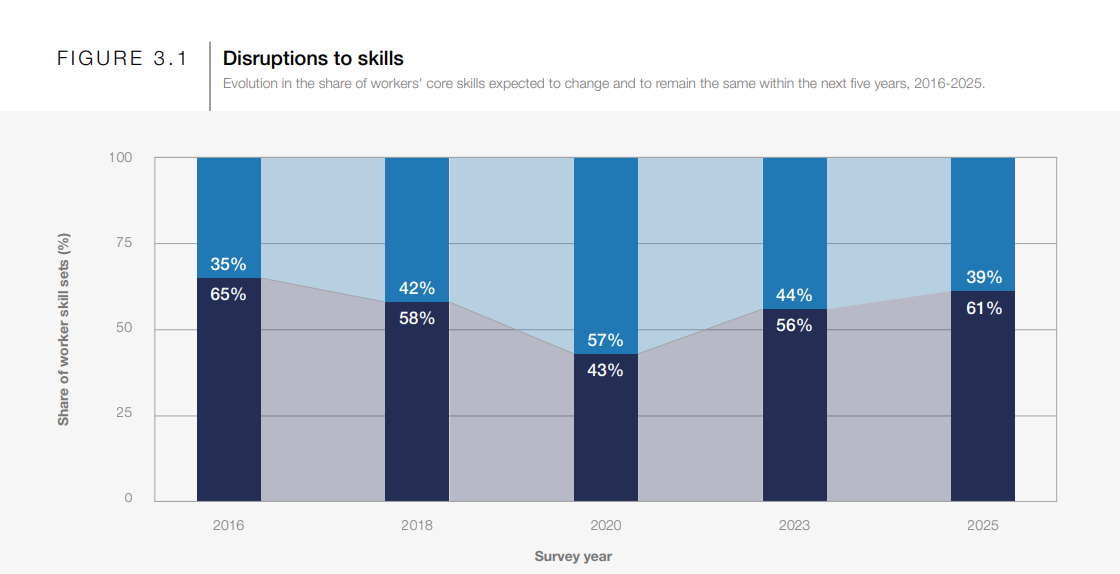
For the WEF, this is likely to be because employers have invested in more training over the past five years – 50% of workers have completed training in 2025, up from 41% in 2023.
Importantly, while tech skills dominated the fastest growing skills over the next five years, analytical thinking is the most sought-after skill by employers. Seven in ten see this as essential in 2025.
Not far behind was resilience, flexibility and agility, and leadership. These human skills also remain important looking ahead to 2030.
For the WEF, there is a need for employers to continue to invest in reskilling and upskilling as the skills landscape evolves.
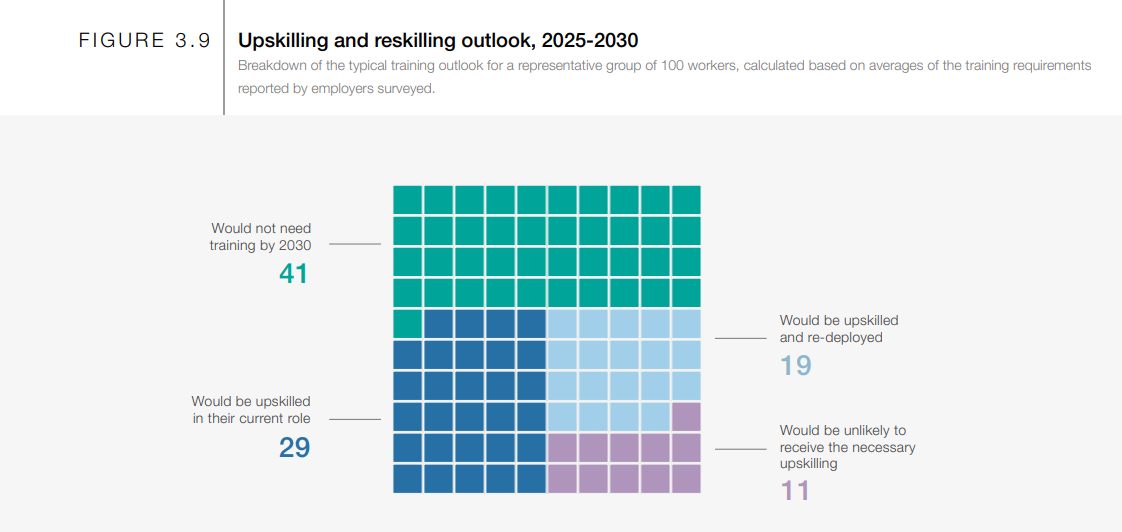
The report found that of a representative sample of 100 workers, 41 won’t require significant training by 2030, but the remaining 59 will need some type of upskilling or reskilling .
11 will need training (but it won’t be accessible to them anytime soon), 29 will need training and will be upskilled in current roles, and 19 will be reskilled and redeployed within their organization by 2030.
2024 saw a lot of headlines about the end of diversity, equity, inclusion and belonging (DEIB) at work.
In contrast, the WEF’s Job report found that organizations are more focused than ever on these initiatives.
83% of employers have implemented DEIB initiatives, up from 67% in 2023 – this rises to 95% for organizations with over 50,000 employees.
The good news is that this investment isn't slowing down – 51% of leaders said they planning to run trainings for managers and staff on DEIB, while 42% were focused on goals and quotas around DEIB (up from a quarter in 2023).
The primary reason why DEIB stays high on the business agenda is because of its potential to solve the business problem of decreased talent availability.
37% said that inability to attract talent to the industry was a barrier to business transformation, while 27% noted that talent attraction to their company was a challenge.
Just 29% expect this to improve by 2030, down from 39% in 2023.
Clearly, business leaders need to think outside the box with talent if they want to thrive over the next five years.
Switching gears, the WEF identified continued economic challenges (and particularly rising cost of living, higher prices or inflation) as having a major impact on transformation of businesses by 2030 (50%).
Despite a decline in inflation in 2024, a global economic slowdown is top of mind for 42% of business leaders.
In fact, slower growth is expected to “drive more job destruction (3 million jobs) than creation (2 million jobs)”.
While the “rising cost of living and higher prices are expected to drive job creation of 4 million jobs and displacement of 3 million jobs by 2030”.
Political volatility is partly to blame here for wider economic slowdown, with geopolitical tensions seen as a business challenge by 34% of organizations.
Demographic shifts also remain a trend for organizations across the world to take note of.
40% of employers surveyed see aging and declining working age populations, as are becoming common in high-income countries, as driving business transformation.
Plus, aging populations drive “growth in healthcare jobs such as nursing professionals, while growing working-age populations fuel growth in education-related professions, such as higher education teachers”.
There's so much food for thought for HR and businesses leaders in the WEF report – stay tuned to see how these trends evolve, adapt and mature over the next five years.