


Fixing the Talent Acquisition Operating Model: Building a Connected Hiring Tech Stack
December 3, 2026

The labor market is on an “uncharted path” and workers are the center of the uncertainty.
Those are the words of ADP Chief Economist and Head of ADP Research, Dr Nela Richardson, in the foreword to the HR giant’s 2026 People at Work report.
ADP surveyed 39,000 workers across 36 regions and found that less than one in five employees are fully engaged, while only 22% felt their jobs were safe.
This is a huge challenge for organizations; to shift those barriers into opportunities, employers, and the HR function specifically, need to alter their decision-making.
UNLEASH dug into the full report, and interviewed ADP’s Chief Talent Officer Jay Caldwell. Here are three calls to action for HR leaders from the data.
“AI is entering a workforce that is anxious,” Caldwell tells UNLEASH.
This is a huge concern for organizations because when people feel safe in their jobs, they are 6x more engaged, 3.3x more productive, and 6.3x highly motivated. In addition, there were 2x less likely to be looking for a new job.
ADP’s data found that “anxiety over job security was particularly acute among lower-paid repetitive task workers and people at the bottom of the management hierarchy,” Caldwell adds.

The reason is that the higher you go up the hierarchy, the more knowledge and influence people have over decisions.
To alleviate work anxiety, organizations need to be more transparent with people. For HR, this means actively supporting leaders to have open conversations with their teams about fear.
“Naturally, leaders struggle with these types of things because they feel risky, but this is the moment to lean into that or helping their team understand ‘here's how your job might be reshaped or here’s how it will shift and how we’ll support you in the transition’,” shares Caldwell.
ADP’s data also showed that organizations need to invest in people’s careers.
Workers who felt they had the skills to advance in their careers were 5x more likely to view their job as safe. Those who said their employer invested in their learning and development were 5.3x more likely to feel secure.
Caldwell notes: “Skills development is important. What's just as important is HR thinking like marketers in terms of promoting loudly: ‘how are we investing in your skills?’
“Very often that falls behind the wayside, so HR has to think very carefully around how do we make it valuable, clear, and create the space in the organization for people to spend the time to invest in themselves.”
ADP’s research uncovered an AI productivity paradox.
As Caldwell puts it: “While heavy AI users showed higher engagement, less stress, and more positive feelings about their teams, they also said they felt less productive.
"In fact, daily users of AI were 4x more likely than non-users of AI to say they were less productive than they could be.”
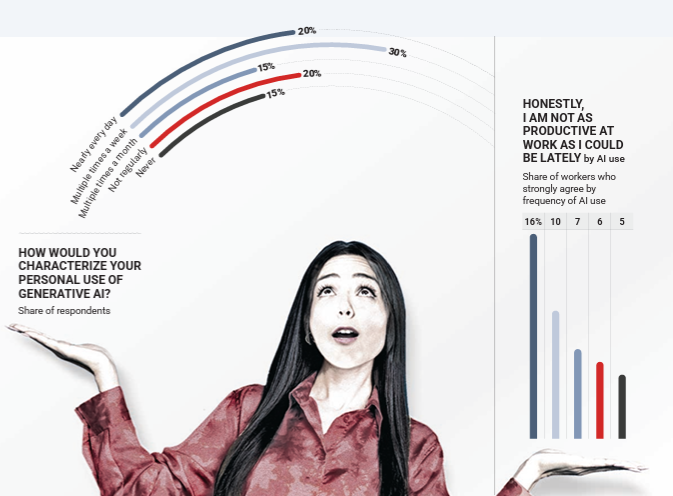
This seems counter-intuitive, given that the biggest expected benefit of AI is increased productivity.
For Caldwell, the reasoning is “probably the change in the traditional change code that people go through where they feel as they're adopting new things, their productivity dips.”
The action for HR leaders is to redefine what productivity looks like – as tools can do more and more tasks “we need to help reframe productivity for our workers because there’s less of those little task completion moments.”
This means focusing on “strategic contribution, making great decisions for long range impact instead of short-term productivity." Therefore, “looking at things like decision quality, judgment, and collaboration should be critical factors as we think about measuring performance within an organization.”
A big focus of ADP’s 2025 People at Work report was on generational differences. This is because there are five generations in the workforce for the first time in history, which brings both opportunities and challenges.
Older workers are more likely to doubt their skills, whereas younger workers were more optimistic about their career prospects.
Just 19% of over 55s said they had the skills they need. This compares to 29% for 18- to 26-year-olds and 30% for 27- to 39-year-olds.
Only 12% of over 55s also noted that their employee invests in the skills they need, compared to 21% for both the 18 to 26 and 27 to 39 age groups.
However, older workers also felt less stressed in their jobs than their younger colleagues – they were also more likely to be thriving and less likely to be overloaded.
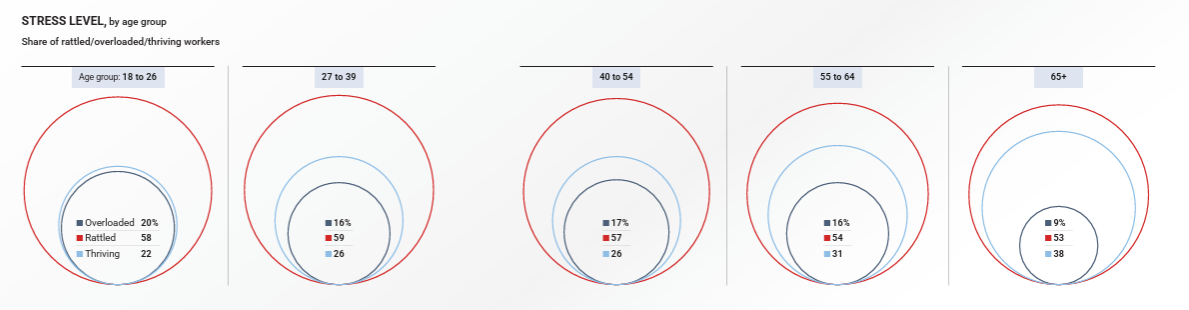
This means that as HR leaders are making decisions for the workplace, thee take one-size-fits-all approaches. Instead, they need to lean into the strengths of each generation, and embrace mentorship across multiple generations.
“We've traditionally called that reverse mentoring. I've never seen such good evidence for it right now because we have an early workforce that's more AI native, particularly those that will be coming out of college in the next four years,” notes Caldwell.
“AI offers the opportunity to move faster by having expertise at your fingertips, but what's lacking is experience.
"And so, if you need to move faster to apply knowledge and expertise, how do you then accelerate the experiential side or the judgment side of your work? And that's where your tenured workers can add significant value.”
HR, are you ready to take action?