


Scaling AI with Confidence: How Lockheed Martin Built the Foundations for HR Transformation
December 8, 2026

46% of CHROs are not invited into the room when AI strategy is being decided.
That’s according to IBM’s 2026 CHRO Study, which surveyed 1,500 HR leaders and 8,800 employees.
The report warned that two different potential futures for HR are emerging: “Five years from now, CHROs will have either helped build the future of work – or been made irrelevant by it.”
“If the CHRO doesn't take the lead on defining how people put AI to work, the CTO, CFO, or COO will. And in much of the market, they already have.”
Those CHROs who are not just be in the room but become the architect of how people and tech work together will forge what IBM termed ‘Thinking Organizations.’
Thinking Organizations don’t necessarily use more AI; they use the technology intentionally to rethink how work gets done and how the business creates value. IBM found that these organizations will see 2x revenue uplift, stronger workforce outcomes, and higher innovation throughput.
“There is no universal playbook” for this work, Nickle LaMoreaux, CHRO at IBM, stated in the report. Here are three actions HR leaders must take to seize control of their future and avoid irrelevance.
The stat that nearly half of CHROs are not involved in AI strategy decisions has wider context; 72% of HR leaders said there is limited or no AI use within their own function.
CHROs rate HR’s capabilities as "low” across a range of AI workforce transformation metrics: AI literacy (13%), AI performance management (16%) and human-AI workflow design (21%).
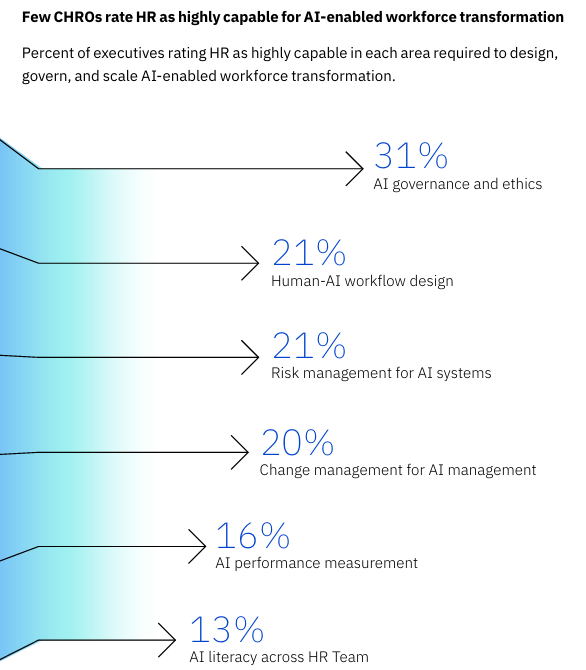
If CHROs want to guide enterprise workforce transformation, they need to start within their own function. While CHROs are focused on their own digital and AI fluency (71%), they need to invest in building those capabilities across the entire function.
The next step is to make “HR the first environment to design, test and refine AI-enabled work.”
This action is not just good for HR, but for the whole organization. Organizations with mature HR AI capability – in terms of governance, architecture and measurement – are nearly twice as likely to report a higher number of positive business KPIs.
Once CHROs have fixed their own function, the next step is to truly seize ownership of “the human-capability agenda in every room where AI’s role is being decided.”
73% of CHROs admitted to struggling to align C-Suite decisions about how? AI will impact work and the workforce. Furthermore/Meanwhile,, 36% of leaders noted that unclear AI accountability complicates deployment.
The best place to start, according to the report, is an inventory: “Where is AI already shaping employee and manager decisions, and which three to five workflows carry the highest stakes for human judgment?”
Then share the inventory findings with IT, Operations, Finance and other leaders, to ensure that “AI transformation is guided by clear human and organizational principles, not treated only as a technology rollout.”
HR being accountable for the human side of AI has a knock-on effect on employee confidence in the tools.
41% of employees told IBM they didn’t feel safe challenging or overriding AI outputs; plus, 43% said when something goes wrong with AI, the blame falls on them.
This switches when CHROs take responsibility for what decisions remain human led: “Employees stop deferring to the machine and start supervising it.” They exercise judgment – and it is human judgment that drives business value and competitive advantage.
It’s not only CHRO’s AI ownership challenges that are preventing employees from exercising judgment and properly scrutinizing AI.
IBM’s data found that CHROs and employees disagree on the importance of supervising and validating AI – 71% of leaders prioritize the ability to supervise, validate or over-ride AI outputs, compared to just 38% of workers.

While organizations are focusing on skills gaps, they are overlooking an equally important threat: ‘skills erosion,’ which IBM defines as the skills “quietly degrading as AI takes on more of the thinking.”
The action for HR leaders is to build continued use of judgment into “development plans, manager coaching, rotations, stretch assignments, and succession planning” – then “track whether proficiency is holding as AI adoption grows and intervene early when it begins to decline.”