

'Digital Me' is turning human capability into corporate assets. HR must push back
April 27, 2026

There’s a reason the manufacturing giants of the 1960s and 1970s are no longer the global financial powerhouses they once were.
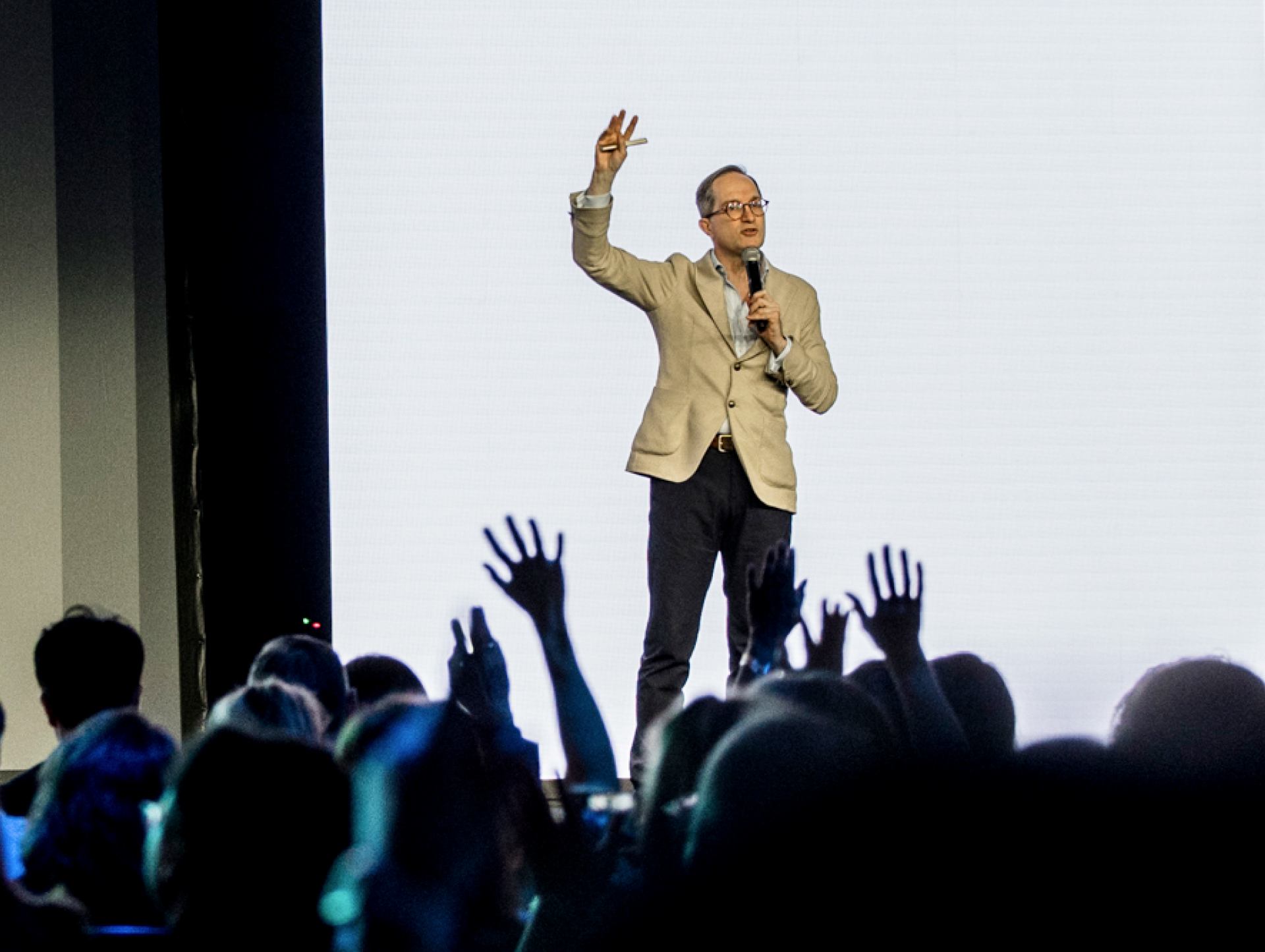
Vineet Nayar, Founder-Chairman of Sampark Foundation and Former CEO of HCL Technologies, believes that reason is simple: organizations that leveraged new technology as simply a productivity tool have been left behind.
Meanwhile, companies that used tech to reinvent their business models – he points to Apple, Amazon and Tesla as prime examples – have thrived in the digital age by inverting the organization pyramid.
Nayar tells UNLEASH that HR leaders face more than a similar choice in the AI era: they have “the mother of all opportunities.”
HR leaders “are the only people who can create an empowered organization,” upending the traditional hierarchy and placing AI into the hands of the workers.
Nayar’s premise is that how organizations create value has shifted. AI has democratized knowledge, so its value has decreased; meanwhile, experience that took decades to build is now embedded into technology in minutes.
In this operating environment, the historic top-down model, in which CEOs and other business leaders hold the most experience and knowledge, is no longer viable.
Indeed, organizations seeking to compete must “create alternate differentiators.”
In the future of work this will be people, Nayar states, specifically those enabled and empowered by AI to “invert the organization pyramid.”
“There is an opportunity for HR because they are the only people who can create the alternate organization, which is an empowered organization when AI is under the employee.”
Nayar highlights that previously CEOs have often come from a sales background, or finance roles during times of recession and depression, then technologists during digital transformation.
His vision is that HR-trained CEOs will come to the fore next armed with an understanding of people and cultural transformation required for organizations to flourish in the AI era.
Hence, the “mother of all opportunities,” according to Nayar. At the same time, HR leaders need to be aware of the potential pitfalls AI creates along this path.
That repetition of “industrial age” thinking that led to the downfall of the manufacturing giants of the 1960s is a trap. Instead, leaders that use AI to empower employees and introduce innovation will be in line for the C-Suite.
HCL Technologies, the multinational IT organization Nayar led between 2007 and 2013, offers tangible evidence of how inverting the organizational pyramid goes beyond theory into successful practice.
Management were made accountable to employees through open and transparent appraisals. Nayar says his own was conducted by “100,000 employees in 32 countries, and the results were published for all to see.”
He draws a straight line between these types of hierarchy inversion and the growth achieved by HCL during his tenure to $50 billion in market capitalization. The underlying principle was creating an interface between employees and customers – rather than escalating decision-making or responsibility up the ladder.
Nayar also highlights that these efforts were driven by cultural transformation, because AI wasn’t available at that time.
“That [result] has already been proven by us, and then many other organizations, which implemented the ‘employee first’ model. Now, with AI coming in, that becomes much easier because now the employee has the tool,” he says.
This means the role of leaders and managers has “changed dramatically,” moving from supervision to actively teaching employees “how to be curious, how to frame the problem correctly, how to be decisive, and how to rematch.”
AI may change how some roles and tasks are done in the future of work, but reframing the skills that enable the use of AI is fundamental.
The question then becomes: If every organization has AI, what human capabilities should HR leaders and their companies be investing in as a differentiator?
There are four, according to Nayar: framing the right hypothesis or question, interpreting signals uniquely, the ability to decide, and the ability to reimagine.
The prospect in front of HR leaders is arguably larger and more achievable than ever before – driving the future of work now through workforce redesign and upending the established order of hierarchy.
But that path is only open to those that can seize the moment now. For HR leaders with ambitions to lead these efforts, Nayar reiterates the danger of falling into productivity traps by using AI as surveillance and control tools, instead of trusting in employees to innovate autonomously.
“If that happens, then this opportunity is lost for you. You have to reimagine and you have to sell that dream to the Board, not do what the manufacturing companies did and lose out on opportunity.”
Ultimately, if HR is to be the driving force for the future of work, Nayar says it will all come down to leaders taking the initiative: “If you follow, you are dead. If you take the lead, then you are the future CEO.”