


The ladder is missing rungs: Where will your next senior leaders come from?
October 6, 2026

More than 30% of workers feel concerned about AI replacing them in their roles and were actively looking for or interviewing for a new job.
That's according to new research from payroll services and HR solutions platform ADP, which pooled 38,000 global workers.
What’s more, 10% of worker felt scared that technology would take their jobs, while 17% were optimistic that it would have a positive impact on their role.
To understand how this impacts different sectors and demographics, UNLEASH spoke exclusively with Dr. Mary Hayes, Research Director of People and Performance at ADP Research.
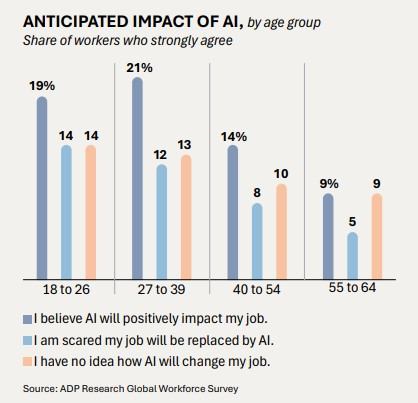
Young workers are both more optimistic and concerned about the potential of AI.
This, the report highlights, may be due to younger generations being more open to considering the impact technology and AI advancements will have on their long-term career.
In contrast, older generations – people 55 years and older – were found to be the most indifferent to AI. The report suggested that this may be because they feel it will have little impact on the rest of their time in the workplace.
Although the report indicated a clear age divide, it also highlights that individuals in different industries are likely to have differing outlooks, too.
For example, tech, finance, and insurance workers were found to have a much more positive outlook on AI, compared to personal services, transportation and warehousing, and health care and social assistance workers.
“The workers we surveyed have a contradictory set of emotions: excitement at its potential and fear of its ultimate impact. Part of this contradiction could be attributed to anxiety about the unknown,” Dr Hayes explains.
“Our findings suggest that there are differences within a given sector and across sectors in the workforce. Knowledge workers are most likely to perceive AI as positive but also have no idea how it will change their jobs.”
From this, the report suggested that employees in sectors that have been early adopters of technology tend to have an more positive outlook on AI overall.
Knowledge workers – professionals such as programmers, academics, and engineers – were most optimistic about the positive impact AI will have on their jobs, but they also were the most worried about AI.
Speaking directly to HR leaders, Dr Hayes concludes: "AI presents significant opportunities for efficiency and innovation, but it also necessitates careful consideration of its impact on the workforce and current practices.”
“Communication can contribute to a supportive work environment that minimizes worker fear and maximizes the potential for AI as a collaborative workplace tool.”