

In an uncertain world, efficiency only gets you so far. Dr Margaret Heffernan on why HR must prioritize creativity instead.
October 20, 2026
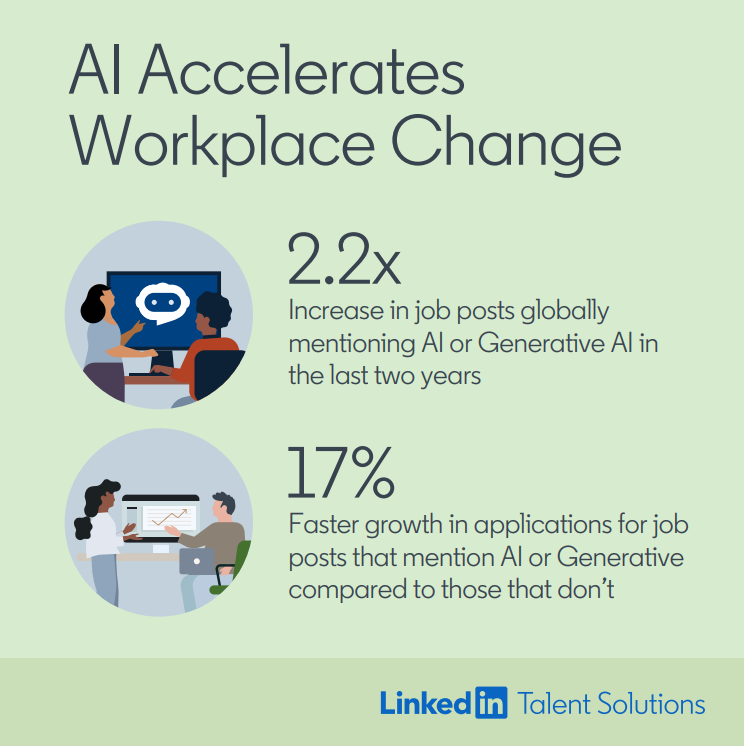
Ever since OpenAI’s ChatGPT catapulted to fame in November 2022, this new emerging technology, generative AI, has dominated the news cycle.
As a result, workers across the world are increasingly becoming aware of the technology and questioning, 'what does this mean for my role?'
Caltech lecturer, futurist and AI expert Ravin Jesuthasan is not doom and gloom about generative AI.
He believes that the benefits of generative AI to workplace are vast, but Jesuthasan is clear this technology is not a silver bullet.
A big worry is that businesses who are too quick to replace junior roles with automation and generative AI may risk depleting the talent pipeline for their future leaders.
For Jesuthasan, one of the main pros of generative AI is that it could trigger “dramatic improvements in productivity” – this is a huge gain for workers, their employers, but also society as a whole.
Productivity is stagnating in developed countries, there are huge skills gaps, and a recession is on the horizon – something needs to change, and quickly.
Another positive of generative AI for Jesuthasan is that it democratizes access to knowledge, opportunities and creativity.
He has spent a lot of time researching the history of tech transformations and their impact on the world of work; not just for his four books, but in his role as global transformation leader at Mercer. In this democratization respect, he sees generative AI as being very similar to the second industrial revolution.
The second industrial revolution essentially saw the “the automations that transformed the world we live – [think] lightbulbs, internal combustion engines, factory equipment”.
And this “took away from highly skilled artisans and craftsmen, and brought the masses into this thing called work” – essentially, technology democratized access to work; it meant that with just “nominal training, lots more people could be engaged in productive work”.
In comparison, the third and fourth industrial revolutions have really shifted the power to the more educated people who can “read, write, think critically”.
Although it is early days, Jesuthasan sees that generative AI is actually democratizing access to knowledge and creativity. It “allows more people into the game” and helps them upskill and get up to speed quickly.
This is line with the findings of economist and Stanford University professor Erik Brynjolfsson.
Taking the example of content creation and writing, a lot of time is spent on gathering data and doing research. For experts, like Jesuthasan, knowledge accrued over many years guides and directs their work. But for less experienced people, maybe those earlier in their careers, they can just log into OpenAI and ask ChatGPT a series of questions.
This democratization has real benefits for workers, and their careers. Yes, it may see talent get displaced from certain jobs and sectors, but pick up better, more creative and meaningful work; AI “can create space for new work or create demand for new types of skills”.
This is a repeat of the second industrial revolution where people moved out of agriculture and into manufacturing, and out of manufacturing into service industries.
Of course, generative AI is not a silver bullet, and there are real concerns that individuals and organizations need to bear in mind when using the technology.
A big worry for Jesuthasan is the impact on the talent funnel.
“Now we’ve cut the legs off that model, so what actually happens going forward? Who is actually being developed to be that next generation of leader?,” Jesuthasan asks.
In addition, despite the benefits of democratizing knowledge, Jesuthasan warns that individuals need to be very aware that, unlike other types of machine learning, “there is an absence of logic in generative AI”.
It can present information as “gospel” or fact, and it sometimes hallucinates and fabricates information completely, which is “deeply problematic”, shares Jesuthasan.
He shares the example of a tech CEO who he was talking to. ChatGPT was insistent that this individual had founded a company in 2014, when he hadn’t – in fact, this individual had nothing to do with the company in question, he had never worked there.
“The reason it does this is because, like the human brain, when there is an absence of information, it has to fill to the gap and look for connections, even those connections might be spurious or nonsensical”.
Ultimately, Jesuthasan is clear that prognostications that generative AI will cause the extinction of humanity just distracts from these real, immediate concerns. It cheapens those real short-term impacts that businesses and individuals need to be aware and cognizant of.
None of these challenges are insurmountable, organizations just need to be “deliberate” about the use of generative AI.
They shouldn’t jump in feet first without assessing the risks, but they also do not need to be so risk averse that they won’t even touch it. Instead, there is a middle ground where you put “guardrails around it”, but you still experiment.
They need to be aware of the copyright concerns linked with generative AI. It pulls data from everywhere, and it does not credit the original source.
“Whatever goes onto OpenAI then becomes freely available to everyone else”, so organizations need to make sure their employees aren’t inputting sensitive or confidential information into generative AI tools.
This is an issue that big employers, like Amazon, Apple, Samsung and JP Morgan, are already grappling with, and has pushed them to restrict (and in some cases ban) the use of ChatGPT at work.
Along another vein, companies need to think about the use cases for generative AI, and not use it for everything.
“But if it’s used for bodies of work, or to substitute human endeavor, particularly if it is substituting someone with a lot of expertise, then you could end up in real problematic situations”.
Ultimately, for Jesuthasan, companies who lead with the work, rather than technology, are best equipped to get the most out of humans and technology.
In order to do this, it is essential that organizations, to take the time to involve the people who will be most affected by it.
“You’ve got to get them to understand generative AI”, but you also have to show them why they should buy in to the use of this technology at work.
A lot of people will think, “Hang on, I am going to redesign my work, and then put myself out of a job”. It is necessary to reassure them that it won’t actually take their job – instead it’ll make their jobs more meaningful, and they will be able to upskill and reskill for their own benefit (as well as their employer’s).
Jesuthasan sees HR teams as having a key role to play here. This is because HR’s mandate has shifted over the past few years – from “a steward of employment” to “a steward of work”.
The department is now key to “helping business leaders and talent redesign work, so that talent can continuously stay relevant in a world that is changing quickly”.