


The Talent Operations Transformation
October 6, 2026
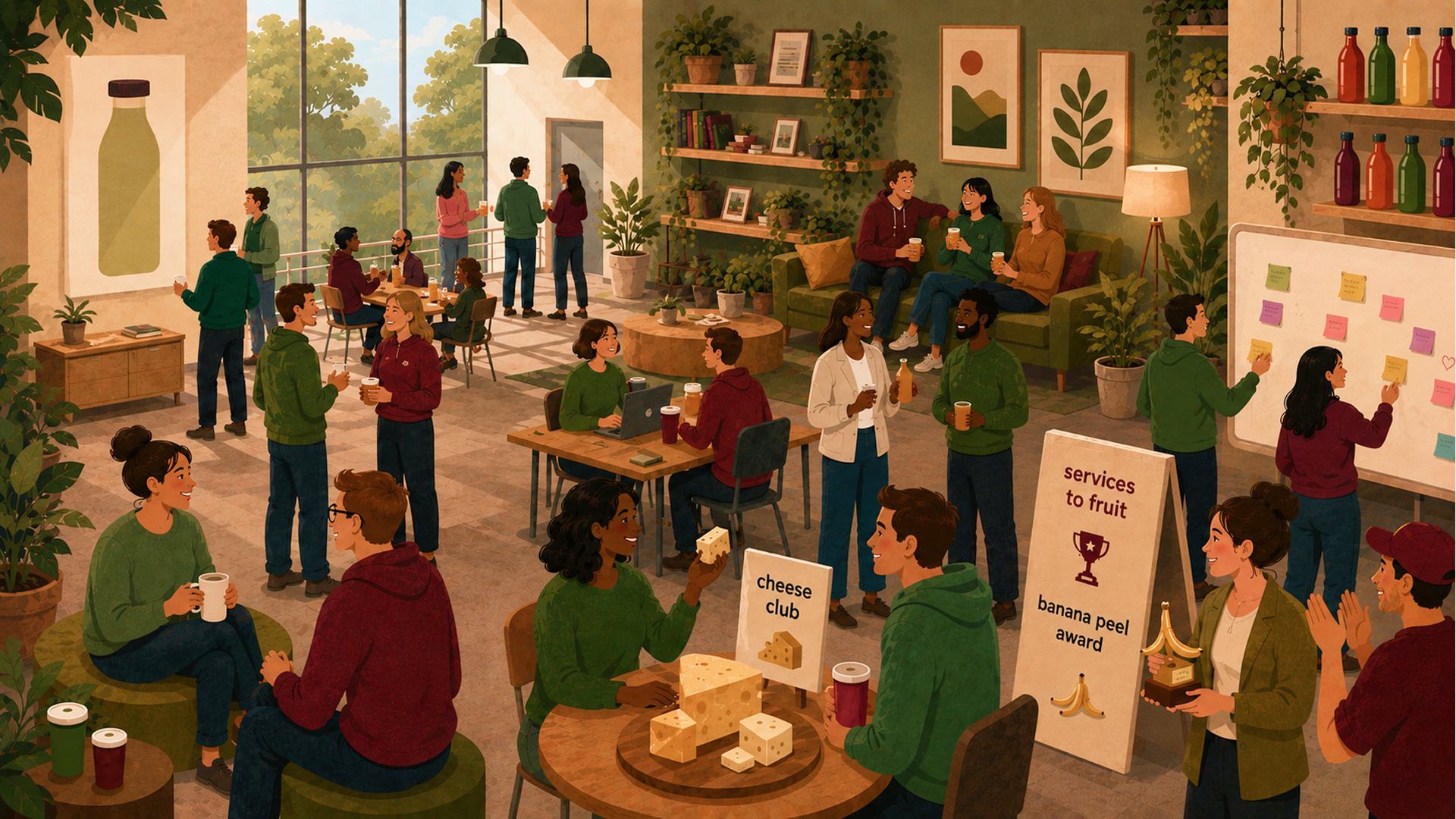
Nobody put ‘start a cheese club’ in the HR strategy.
Yet, cheese club perfectly illustrates the culture of Innocent Drinks, Europe’s biggest juice company.
50% funded by Innocent’s HR team but created by a group of cheese loving employees to determine the cheese of the year, the club is not a gimmick.
It has created a workplace camaraderie so strong that even lactose intolerant colleagues have become invested.
A B-Corp founded in 1999 known for its colorful, fun products, Innocent has more than just a responsibility to make money. It is also committed to investing in creating a culture where people want to work.
David McKay, Head of People Experience, Operations and Culture, describes Innocent as “results-driven and values-led.”
This means balancing the fact that “we’re a business, we’re not a food distribution charity,” with a desire to make commercial decisions that also benefit the planet, the community and Innocent’s 850 employees in 12 countries.
Every single decision made at Innocent focuses on the fact that while “we are there to deliver results, “it’s how we go about that” which really matters.
“Your values should guide the decisions you make,” McKay adds.
Cheese club is far from the only example of Innocent’s values-first approach – UNLEASH spoke to McKay to find out why the drinks giant continues to invest in its culture, and how culture is enabled by its tech partnerships.
Innocent struggled in the aftermath of the COVID-19. It saw sales decline in 2021, but the drinks giant has since rebounded, reporting £13 million in profits in 2025; its first profitable year since 2020.
In these challenging times, Innocent rooted itself in its values and let that guide decision-making.
Rather than cutting funding for its culture programs, the HR team indexed on the importance of keeping people engaged and connected, and telling Innocent’s employees “this is the type of community that we are and want to build”.
This comes to life in a few ways. Innocent ring fences budget for team connection, while encouraging cross-team fun by funding clubs and organizing a day for the whole company out in nature.
“There’s merit to building communities that span beyond just your team – we see huge value in that, so we’ll invest in that.”
Innocent also thinks outside the box on rewards – while it celebrates success through an employee of the month award (called ‘services to fruit’), it also celebrates slip ups via a banana peel award.
Notable examples include accidentally inviting 200 unsuccessful candidates to a first-round interview, and mistakenly discarding fresh stock instead of the expired stock in the next pallet.
“The lesson was that when we rally together, we can fix a crisis really quickly. It takes a psychologically safe culture to hold your hands up and ask for help,” notes McKay.
These human stories are especially important at “a time when we are physically less connected.”
Innocent has been very intentional in its decision-making around in-person versus remote work.
“When we came out of COVID-19, our approach was we know that being together gets the best out of our people.” While also balancing employee desires for flexibility.
Rather than mandating office days, Innocent has created an office environment that people want to commute to.
“Cheese club and a brilliant working environment are not things we do to purposefully lure people back into the office – we genuinely just want it to be when you do turn up, it is a brilliant place to work.”
The proof is in the results.
Innocent has seen positive employee experience – McKay shares: “We’ve managed to keep that at pretty stable levels pre- and post-COVID-19.”
“Connection is one of the most talked about drivers of experience” – 23% of comments in the survey mentioned this – and the primary drivers of connection at Innocent are recognition and psychological safety.
This success was enabled by Innocent’s HR tech partnerships. The drinks giant implemented HCM giant Dayforce in 2021 during COVID-19’s financial challenges.
Thanks to Dayforce, “as People people, we’re not spending all our time on administration. Dayforce has allowed us to spend the time doing the stuff that counts towards experience, engagement and wellbeing,” notes McKay.
Innocent is not taking its foot off the gas when it comes to culture.
McKay explains that “communication is getting more challenging…what’s becoming really evident is that our communication tools are not fit for purpose.”
“We’ve got Dayforce, we’ve got Microsoft Teams, we’ve got Sharepoint – they don’t work seamlessly together. We’ve got work to do on that.”
Innocent generally wants to focus on “maturing our approach to HR operations.” This requires getting HR data “in really good shape,” before looking at how AI can support Innocent with employee experience.
The communication piece becomes even more important as Gen Z enters the workforce – they will be future leaders of the business, but they prefer flexibility and prefer online communication.
“If we want to keep connection and collaboration at the heart of our business – and we know it does wonders – how do you build that for a group that doesn’t have a preference towards that?”
“It’s a challenge, but it’s exciting as well” – if Innocent can get this right, it’ll be a real competitive advantage as the drinks giant looks to build on its 2025 financial success.