


Remote and Payoneer acquisitions to give 'HR leaders the confidence to hire across borders'
January 21, 2026
John Brazier

Geoffrey Hinton – otherwise known as ‘The Godfather of AI’ – has quit Google after 13 years in order to be able to speak freely about his concerns about the future of AI and machine learning (ML).
In an interview with the New York Times, Hinton shared that a part of him regrets his life’s work in the field of AI. This is because of the potential of the newest iteration of AI technology, generative models like ChatGPT or BARD.
Hinton is concerned about generative AI being a tool for misinformation, as well as its impact on jobs. He told the NYT: “It takes away the drudge work….It might take away more than that.”
The impact of generative AI, and technology in general, on jobs is a core part of the World Economic Forum (WEF)’s recently published 2023 Future of Jobs Report.
While the survey of 803 companies that employ 11.3 million workers globally found that technology was driving the fastest declining jobs – and that job losses are expected across administration, and traditional security, factory and commerce roles – overall tech will actually have a net positive impact on jobs over the next five years.
While many companies are predicting job displacement in some areas, the WEF report found this is offset in other areas. Looking at AI in particular, 50% of companies think it’ll create jobs, while 25% think it will cause job losses.
In fact, WEF found that all but two technologies - robots (both humanoid and non-humanoid) - will be job creators.
60% of consumer goods, as well as oil and gas, companies predict job displacement from non-humanoid robots, while the same proportion of IT and tech companies see job creation.
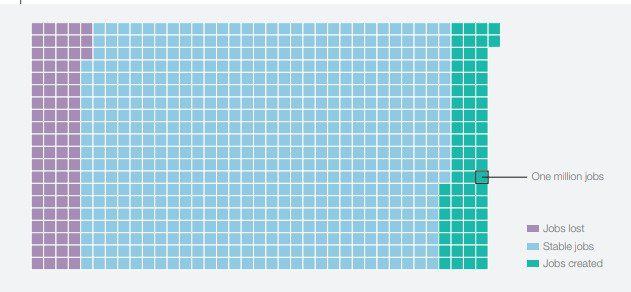
Overall, the report predicts that 69 million jobs will be created by 2027 – technology is helping to drive growth in roles like AI and ML specialists and business intelligence analysts – 83 million jobs will be lost.
This leads to a 14 million net decline (23%), but this represents just 2% of current employment figures.
Ultimately, tech adoption and digital transformation simples changes the skills needed in the workplace.
Over the past few years, there has been a shift from focusing on primarily acquiring new skills by hiring more people, to internal mobility and upskilling current employees.
The good news is that businesses know they need to prioritize the learning and development of their people – the link between internal mobility and the Great Resignation has a part to play here too – but the question that remains, what skills should they focus on?
The top two core skills for 2023 and for the future are cognitive – analytical and creative thinking.
Resilience, flexibility and agility are also core skills now and in the future, as are tech literacy, leadership and curiosity.
Creative thinking will be the fastest growing skill over next five years (73%), followed by analytical thinking (73%) and tech literacy (68%).
Talking about the findings, Saadia Zahidi, Managing Director of the World Economic Forum commented: “There's more of a focus and an interest in having people with analytical thinking, people with creativity.
On the whole, technology isn’t coming for our jobs, but it will disrupt them (44% of core skills will be disrupted by 2027), and force us to lean into our uniquely human capabilities.
Want to hear more from UNLEASH? Sign up for free access to all our online content, exclusive reports, as well as discounts for our events.